
Most hotels treat room service as an afterthought. Here’s how to run it like the revenue center it actually is.
For decades, the symbol of luxury travel was the tray at the door, the silver cloche, and breakfast with a view. Then came delivery apps, a pandemic, and a wave of cost-cutting that led hundreds of properties to quietly scale back or eliminate the service in hotels altogether.
Room service in the hotel industry didn’t retreat due to a lack of guest interest, but because of a failure in the traditional model. Data from SuitePad shows that when hotels stop viewing it as a burden and start optimizing, specifically by reducing or waiving order fees, revenues can increase by as much as seven times. The demand never disappeared; it just needed to be unlocked with the right strategy.
To help you navigate this transition from outdated operations to modern profitability, we have developed a comprehensive framework. This guide provides the tactical roadmap needed to capture the revenue currently being left on the table.
It is specifically designed for General Managers, F&B Directors, and Hotel Owners who want to move room service from a cost center to a profit engine.
What is hotel room service?
Hotel room service is a premium hospitality service where guests order food, beverages, or amenities to be prepared by the hotel’s kitchen and delivered directly to their private rooms.
But the operational reality extends far beyond that definition. Traditional room service operated reactively: the phone rings, the kitchen fires the order, a server delivers it. Modern room service is proactive: digital menus, 24/7 concierge, in-app push notifications for late-night snacks, and AI-powered recommendations based on guest profiles replace the passive wait.
The shift from reactive to proactive is the single biggest lever operators have to increase order volume without adding headcount.
Defining high-quality hotel room service standards
Consistency is the bedrock of exceptional service. A guest’s experience should not fluctuate based on who is working the night shift. High-quality service is defined by the seamless execution of the three pillars: speed, temperature, and presentation.
To achieve this, hotels must implement rigorous SOPs (Standard Operating Procedures). Every delivery, regardless of who is on shift, should follow the same sequence: tray assembly checklist, knock-and-announce protocol, placement in the room, order verification with the guest, and departure etiquette. Without documented SOPs, quality becomes shift-dependent.
Of course, what “good” looks like varies significantly depending on your property’s positioning. The benchmarks for a standard hotel and a luxury hotel are not the same and confusing the two is a fast track to either over-spending or under-delivering. Here’s how the two tiers compare across the attributes that matter most:
| Attribute | Standard Hotel | Luxury Hotel |
| Delivery time target | ≤ 30 minutes | ≤ 20 minutes |
| Menu availability | Limited (breakfast/dinner) | 24 hours |
| Presentation | Standard serviceware | Branded china, linen napkins |
| Order channel | Phone | App, QR, in-room tablet |
| Upsell capability | Basic | Automated digital upselling |
| Tray retrieval | On request | Proactive hallway monitoring |
Training staff for excellence in hotel room service
Your room service team is simultaneously kitchen liaison, delivery professional, and sales associate. That’s a demanding combination that requires both technical and interpersonal training.
Technical training covers the physical mechanics: how to load a tray while balancing it, managing a heated cart through narrow corridors, timing delivery from kitchen pass to elevator to guest floor. These are learnable, repeatable skills.
Interpersonal training is where many properties fall short. Staff need to know how to knock (announce the hotel name, not just “room service”), how to position themselves in the doorway without intruding, how to verify the order efficiently, and how to close the interaction warmly without lingering.
The highest-value interpersonal skill is upselling. A well-timed “Would you like to add a dessert or a bottle of still water?” at the moment of order. Train staff with scripted suggestions, then let them adapt to the guest’s tone.
Operating in a role that blends logistics, hospitality, and sales, all under time pressure, often with guests from different cultures and communication styles, demands more than technical know-how. The human side of room service runs on a specific set of soft skills that separate a functional delivery from a genuinely positive guest experience:
- Active listening (capturing orders accurately under noise/distraction)
- Calm composure under time pressure
- Clear verbal communication with non-native English speakers
- Discretion and respect for guest privacy
- Genuine warmth without being intrusive
- Confidence to suggest additions without being pushy
How hotel room service impacts RevPOR
For years, hotels have watched revenue walk out the door with every food delivery driver that pulls up to the lobby. A modernized room service strategy allows you to capture that spend, directly boosting your RevPOR.
RevPOR, Revenue Per Occupied Room, is the metric that tells you how much total revenue each occupied room generates beyond the nightly rate. Room service, minibar, spa charges, and parking all feed into it.
The impact of a well-run room service program goes beyond a single line item on the profits and losses. It creates a ripple effect across financial performance, day-to-day operations, and brand positioning as the breakdown below shows:
| Benefit Category | Impact on Hotel Operations |
| Financial | Increases non-room revenue and average check size through digital upselling. |
| Operational | Reduces lobby congestion and off-site delivery traffic. |
| Marketing | Enhances brand prestige and supports higher ADR (Average Daily Rate). |
Overcoming operational challenges in hotel room service
Room service has real operational costs: labor, food waste, and tray retrieval logistics top the list. Ignoring them erodes the margins that make the channel worthwhile.
Labor is the largest variable. Dedicated room service runners during peak hours (7–10 AM, 6–9 PM) are justified by volume; the challenge is off-peak coverage. Cross-training banquet or stewarding staff to handle low-volume periods reduces idle labor costs.
Food waste is driven by over-production and over-ordering. Digital menus with real-time availability flags prevent guests from ordering items already sold out, while predictive ordering based on historical data helps the kitchen prep only what’s needed.
Tray retrieval is an underrated operational headache. Trays left in hallways are an eyesore, a safety hazard, and a common source of guest complaints. Technology has a direct solution here: tray-tracking sensors and “tray ready for pickup” alerts from in-room tablets allow housekeeping to retrieve efficiently without relying on guests to remember to call.
Balancing cost control with service quality is what separates a sustainable room service operation from one that’s constantly fighting to justify its own existence. The good news: most of the biggest cost leaks have practical, low-complexity fixes. Here are the three highest-impact actions operators can implement immediately:
Cost-Reduction Hacks for Hotel Room Service:
- Use demand forecasting to right-size prep. Analyze order data by day of week and season. Pre-portioning high-volume items during slower kitchen hours cuts both labor and waste.
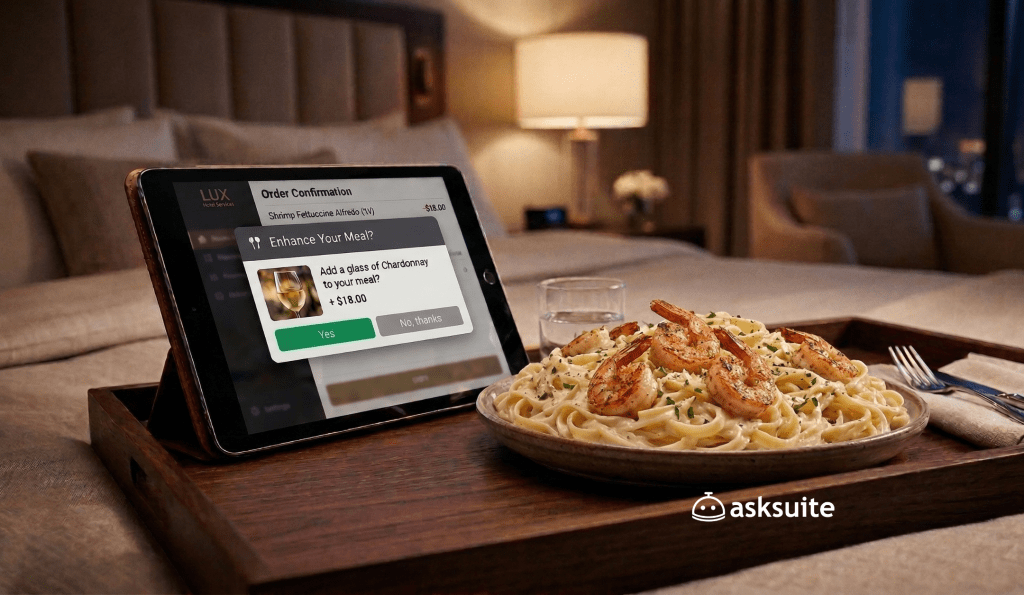
- Implement a digital order system with upsell prompts. Automated suggestions increase revenue per order without adding staff time, directly improving margin.
- Create a dedicated tray retrieval schedule. A 15-minute hallway sweep every two hours costs far less than emergency housekeeping calls and prevents guest complaints.
Technological innovations in modern hotel room service
The technology stack that powers modern room service is straightforward, but the integration between systems is where most properties leave money on the table.
The critical link is PMS-to-POS-to-KDS (Property Management Systems to Point of Sale to Kitchen Display Systems) integration. When a guest orders via app, QR code, or in-room tablet, that order should flow directly to the Kitchen Display System (KDS) without manual re-entry, and the charge should post to the folio automatically via the Property Management System (PMS).
AI-driven demand prediction allows kitchens to anticipate peak periods: Sunday brunch, post-event dinner surges, holiday breakfast rushes, and staff and prep accordingly. When integrated with the hotel’s event calendar and occupancy data, these systems can reduce both rush-hour bottlenecks and off-peak waste.
Knowing which technologies to prioritize and which integrations are non-negotiable is half the battle. Whether you’re building a room service tech stack from scratch or auditing what you already have, this checklist covers everything a modern operation needs to run efficiently in 2026:
- [ ] Digital ordering via guest-facing app or QR-linked mobile menu
- [ ] KDS with direct order routing
- [ ] PMS integration for automatic folio posting (zero manual charge entry)
- [ ] POS with built-in upsell prompt configuration
- [ ] Tray tracking or in-room “tray ready” notification system
- [ ] Demand forecasting module (standalone or within PMS)
- [ ] Real-time order status visible to guests (“Your order is being prepared”)
5 menu engineering strategies for profitable hotel room service
Not every menu item belongs on a room service menu. The filter is simple: does it travel well and deliver a strong margin? Research from Cornell University’s School of Hotel Administration found that hotels implementing menu engineering practices saw a 10% increase in sales. This is proof that what you put on the menu, and how you position it, is a strategic decision, not just a culinary one. Here’s where to start:
- Prioritize dishes that hold texture. Pasta, risotto, soup, grain bowls, and sandwiches maintain quality over a 20–30 minute delivery window. Crispy-skin proteins, delicate salads with dressed leaves, and soufflés do not.
- Build a high-margin core. Pasta dishes, gourmet sandwiches, and curated charcuterie boards carry low food cost and high perceived value. These are your stars.
- Feature a clear “signature item.” One dish that is unique to your property, a chef’s specialty, a local ingredient showcase, creates talking points and repeat orders.
- Use your digital menu to drive cross-sells. “Guests who ordered this also added…” logic, powered by order history data, works in hospitality just as it does in e-commerce.
- Price strategically, not apologetically. Room service carries a convenience premium guests understand. Most hotels add a service charge of 15–20% and sometimes a separate delivery fee of $3–$7 per order.
Applying these strategies is easier when you know where each item already sits in terms of margin and guest demand. Based on industry F&B benchmarks, some item types consistently outperform others in the room service context, either because they travel well, carry low food cost, or both. Use the breakdown below to identify your stars and prioritize them on the menu:
| Item Type | Profit Margin | Popularity | Recommendation |
|---|---|---|---|
| Gourmet Burger | High | Very High | Use as a “Star” item with premium add-ons. |
| Fresh Pasta | Very High | High | Best for late-night “Comfort Food” margins. |
| Seafood/Steak | Medium | High | High revenue, but requires strict temperature control. |
| Artisan Pizza | High | High | Excellent for batching and easy delivery. |
FAQ: Common questions about hotel room service
Is hotel room service still profitable?
Yes, if automated. By reducing manual order-taking and using digital upselling, hotels can significantly lower labor costs while increasing the average check size.
How to reduce delivery times for hotel room service?
Optimize kitchen-to-room routes and use a dedicated “runner” during peak hours. Integration between the order platform and the KDS is also vital to eliminate “dead time” between the order being placed and prep starting.
What is the average service fee for hotel room service?
The industry standard currently sits between 18-24%, often accompanied by a flat delivery fee (e.g., $5.00). Transparency is paramount; ensure these are clearly stated on the digital menu.
How can digital menus improve the average check size?
Digital menus allow for “intelligent upselling”—automated prompts for side dishes, premium drinks, or desserts that staff might forget to mention over the phone. Properties using high-quality digital platforms often see a 10–15% increase in average order value simply through visual appeal and consistent cross-selling.
Does a limited menu negatively impact the guest experience?
Quite the opposite. In the modern landscape, a “concise but curated” menu is preferred over an exhaustive one. By focusing on high-margin items that travel well and maintain temperature (the “Three Pillars”), hotels can reduce food waste and labor costs while ensuring every delivered meal meets a premium standard.
Standardizing your service is only the first step toward true operational excellence. If you want to dive deeper into how to scale your service quality across your entire property, check out our guide to automate customer service.