
From fragmented data to full operational clarity, discover the technologies redefining team management in hospitality.
Managing a hotel is no small feat. Hotel managers often face the challenge of ensuring smooth operations while driving growth in an ever-expanding industry. International travelers increased by more than 1 billion between January and September compared to the same period in 2024. Is your hotel equipped with the right tools to manage this surge?
One of the most pressing concerns is the lack of visibility over workforce efficiency in handling high demand and fragmented information. With critical insights scattered across different systems and channels, it can be hard to take strategic actions that truly drive results.
This blog post explores 3 essential solutions to help hotel managers streamline staff tracking, monitor output, and lead with analytics. These resources are designed to eliminate guesswork and give managers a clear, actionable view of the hotel’s growth.
3 essential tools for hotel managers
The right technology is essential for hotel managers to transition from reactive to proactive communication between the hotel and travelers. Leveraging advanced tools can significantly improve operational control and enhance reservation agents’ efficiency.
Besides, these solutions will give relevant data to further adjustments, delivering even better results in terms of SLA, revenue and service quality.
#1: Omnichannel Communication Platforms
For a hotel manager, having reservation agents switch between tabs for WhatsApp, email, Facebook, Instagram, and website is a recipe for losing revenue from direct bookings. When a traveler sends a message and doesn’t receive a quick response, they simply move on to the next hotel or book through an OTA.
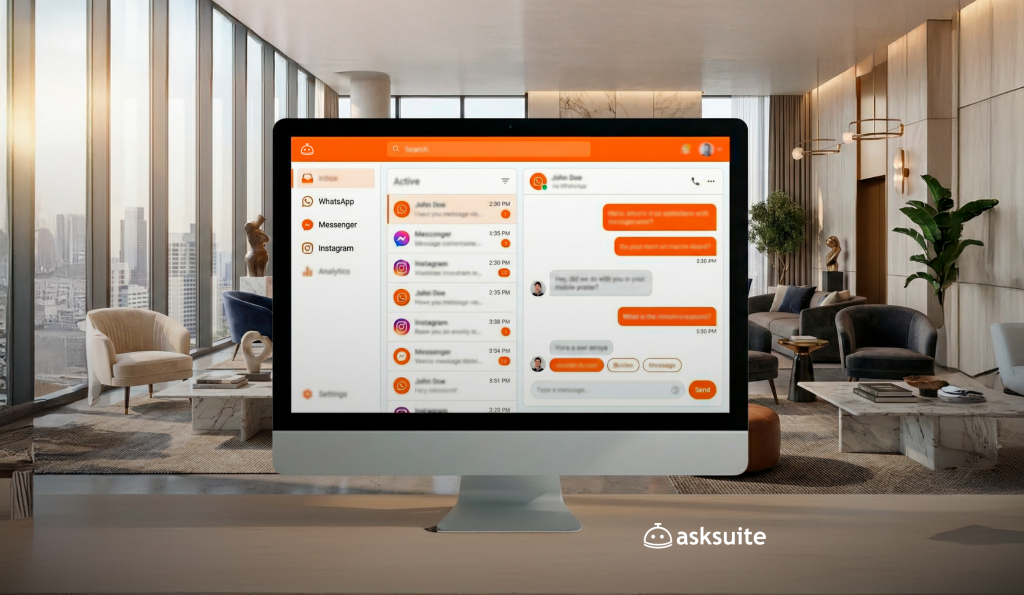
Omnichannel communication platforms solve this problem by centralizing all service channels on a single screen. If it relies on an AI Reservation Assistant to deal with FAQs and drive a smooth booking process, it’s the perfect match!
But what does this mean in practice for communication with travelers?
- Complete performance visibility: Integrated dashboards display essential metrics such as first response time, conversion rate per agent, and service volume per channel. You can quickly identify which team members convert best and which need additional training.
- Reduced operational workload: Asksuite data shows that 50% of interactions with travelers happen outside business hours when your reservation team isn’t available. With AI handling FAQs and lead qualification 24/7, your team can focus on more complex and strategic interactions.
- Direct revenue impact: Real cases demonstrate the potential. Galgorm, a luxury resort in Ireland, generated direct bookings worth over $ 358,000 and achieved a 23x ROI using Asksuite’s platform. ATKV Resorts, with seven properties in South Africa, generated $150,000 in new business in just 9 months.
#2: Integrated Analytics Dashboards
Ask any reservation manager about their biggest frustration, and you’ll likely hear the same answer: data fragmentation. Critical metrics are trapped in separate silos: WhatsApp here, email there, booking engine somewhere else, social media scattered across multiple platforms.
The result? Hours wasted manually compiling reports and critical conversion patterns that never surface.
- Why dashboards are game-changers for hotel managers:
Dashboards, like the SLA one by Asksuite, provides real-time visibility into key metrics, allowing managers to monitor conversation response times, agent workload distribution, and SLA compliance, while helping prioritize requests with higher chances of conversion as well. This means that besides tracking performance, you’re actively identifying which opportunities deserve immediate attention.
- The strategic benefits in practice:
Real-time performance monitoring: With Asksuite’s Sales Performance Dashboard, you can view results from the last few minutes, today, this week, or last month for both your human team and your AI, processing large volumes of data quickly. This real-time visibility allows you to set goals, launch incentive programs, compare team performance, and keep everyone motivated and focused on results.
Complete conversion funnel visibility: Unlike tools that only show service metrics, Asksuite’s dashboards offer a complete view of the conversion funnel across all service channels, including conversion funnels for both human and AI interactions. You can see exactly where travelers drop off and identify bottlenecks. For example, discovering that your Instagram inbox underperforms due to lack of human follow-up on leads.
AI and human performance combined: a hotel manager must have access to the impact of AI on service and sales, including metrics such as interaction volume during and outside business hours, number of quotes sent, and bookings made by the AI. Critically, useful dashboards reveal both what AI converted and the qualified leads it generated for your team to pursue opportunities that can be followed up manually or automated via WhatsApp.
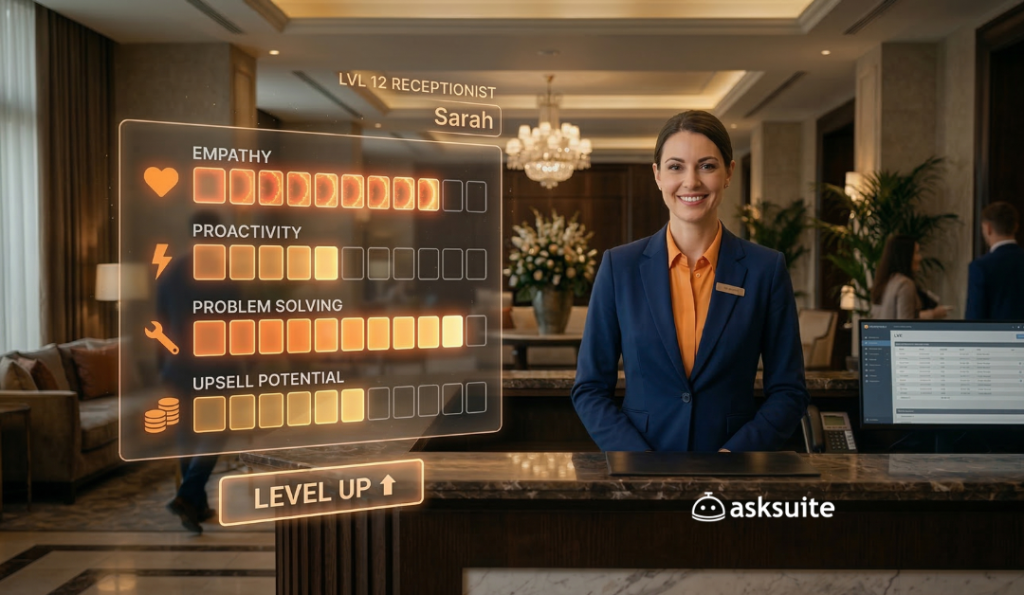
Data-driven team optimization: Decision-makers at hotels are better informed with a detailed view of team performance, enabling quick adjustments based on qualitative and quantitative data, while organizing information by agent, interaction type, response time, and more with customizable filters.
Practical tip: Start by defining your top 5-7 essential KPIs. Common metrics for hotel reservation teams include:
- First response time
- Conversion rate per agent
- Interaction volume by channel
- Quote-to-booking conversion rate
- Revenue generated per channel
- AI vs. human performance comparison
- After-hours engagement rate
Now it’s easy to periodically report performance to leadership and investors with clarity and speed, transforming what used to be hours of manual data compilation into a few clicks.
#3: PMS with Advanced Reporting and Smart Integrations
Most hotel managers use a PMS, but few extract its full strategic potential. A basic PMS records reservations, but an advanced one with robust reporting capabilities can transform raw data into actionable intelligence about cancellation patterns, revenue sources, and operational bottlenecks.
But here’s where it gets truly powerful: when your PMS integrates seamlessly with your omnichannel communication platform and booking engine, you unlock automation that eliminates duplicate work and captures revenue that would otherwise slip away.
- What these integrations actually enable:
Automated reservation input: When connected with an omnichannel platform or booking engine, the PMS automatically receives new reservations without requiring manual input, reducing the risk of overbookings. No more double data entry. A traveler books through your AI assistant or booking engine, and the reservation instantly populates in your PMS with all guest information already filled in.
Abandoned cart recovery that converts: This is where integration becomes revenue recovery: when the omnichannel platform is integrated with the PMS, it’s possible to automate personalized timely messages to travelers who are likely to book.
Did you know? Asksuite clients using this strategy achieved a 40x average ROI.
Here’s how it works in practice: when a traveler requests a quote but doesn’t complete the booking, the system automatically detects this through PMS and booking engine integration, then triggers a personalized follow-up message via WhatsApp.
Want to know more about this feature? Get to know AskFlow Agents!
Real-time operational intelligence: When systems are connected, hotel managers can monitor KPIs from a centralized dashboard, with real-time data pulled from the PMS, booking engine, RMS, and CRM, helping managers respond quickly to demand fluctuations, guest feedback, and performance trends.
From insight to impact: Managing with clarity and control
Clear data visibility has become essential for modern hotel management. With the right technology, managers can lead proactively, optimize team performance, and make faster, more informed decisions.
Unified communication, centralized dashboards, and advanced PMS reporting all work together to dramatically shift routine operations into strategic growth opportunities.
Want to see what this looks like in a real-world operation? Explore the full Royal Resorts case study and learn how their reservation team used integrated tools to generate 3 million dollars in direct booking quotes, through smarter communication, data visibility, and performance tracking.