
How to turn the 2026 travel surge into direct bookings using conversational AI, integrated systems, AI multi-agents, and WhatsApp.
As 2026 kicks off, the hospitality industry is bracing for a travel landscape defined by record-breaking demand and the massive resurgence of global mega-events. While a packed calendar of large-scale gatherings serves as the ultimate stress test for operations, it is merely the catalyst for a broader trend:: travel is booming, and “event tourism” (from international concert tours to major conferences) is filling cities faster than ever before.
Picture your front desk during a peak demand period. Now, multiply that intensity. WhatsApp messages piling up with pricing questions. Email inquiries going stale in the inbox. Phone calls bouncing to voicemail because your agents are busy checking guests in. In this high-stakes environment, your best staff burns out, and frustrated potential guests simply click away to book with a competitor who answered faster.
The thesis for 2026 is simple: hotels without cutting-edge service, automated daily tasks and integrated ecosystems will lose the direct booking battle.
It’s far beyond only competing with OTAs nowadays; it’s about running against the clock. Whether it’s a World Cup final or a local sold-out festival, the winners will be those who are smart enough to handle the volume without crashing.
The clock is ticking. Let’s look at the hospitality trends that will define who will have the victory in 2026.
Trend 01: Conversational AI maturity
It’s time to state the obvious: Conversational AI has transitioned from an emerging experiment to a consolidated trend and a critical operational standard for 2026. We have moved past the era of clunky, script-based chatbots into the age of Generative AI maturity, where Large Language Models (LLMs) and advanced Natural Language Processing (NLP) do not just “reply”, they reason.
For the modern traveler, this level of fluency is a baseline expectation set by major tech and retail platforms. They expect an assistant that understands context, detects tone, recognizes slang, and communicates fluently across languages without friction. If your digital channel feels robotic, the guest assumes your on-site service will be equally impersonal. The real power of this consolidated technology lies in its ability to act as an always-on sales concierge:
- Deep understanding of natural language: Cutting-edge AI goes far beyond simple keyword matching to decipher the true intent behind the message. It effortlessly interprets slang, typos, and complex sentence structures, ensuring that travelers receive accurate, relevant answers regardless of how unstructured or informal their questions may be.
- Precise responses to simultaneous queries: Hotel-tailored AI is capable of answering multiple complex questions sent in a single message without losing context. Furthermore, if a potential guest asks a specific question alongside a quote request, the AI answers the inquiry and initiates the booking process simultaneously, creating a seamless and fluid experience.
- Hyper-Personalization: Gen-AI must be able to converse with the traveler using their real name, creating a natural and welcoming dialogue. Even when the traveler is the one who initiates the conversation on WhatsApp, the AI is capable of identifying their profile and addressing them by name immediately, establishing instant rapport.
In short, mature AI transforms your digital channels from passive information desks into active revenue engines. It ensures that while your staff focuses on more complex activities, your hotel service is always online, attentive, and selling.
Trend 02: Multi-Agent platforms (Agentic AI)
While Conversational AI manages the dialogue, Agentic AI takes autonomous action. This is the defining shift for 2026: moving from a system that merely answers questions to a system that executes routine activities.
In this new operational model, specialized AI multi-agents work alongside your human team, creating a hybrid workforce where the division of labor is clear: AI handles the volume and repetition, while humans manage complexity and hospitality. These agents don’t just wait for a trigger; they proactively engage travelers throughout the guest journey to maximize revenue and efficiency, according to your hotel’s unique necessities.
The three pillars of these Agentic AI workforce are:
- Booking & Revenue: They act immediately when a lead goes cold. If a potential guest starts a quote or abandons the booking engine mid-checkout, the agent autonomously re-engages them with a personalized follow-up message. It ensures no revenue opportunity falls through the cracks due to a busy front desk.
- Concierge: They assume the heavy lifting of repetitive logistics. By integrating directly with your PMS, these agents automatically collect traveler data, send pre-arrival check-in instructions, and explain hotel policies clearly. This frees your human staff to focus on high-value tasks: closing complex sales, managing groups, and delivering the “human touch” on site.
- Marketing: They automate reputation management. Once the PMS confirms a check-out, the agent instantly triggers a personalized feedback request or even an exclusive voucher offering. This ensures consistent data collection and provides an immediate channel to resolve potential issues before they become negative public reviews, reinforcing loyalty.
Does your hotel operation rely on manual follow-ups, or have you already deployed a hybrid team of AI Agents?
Trend 03: Integrated ecosystems
For years, hoteliers have struggled with a fragmented tech stack: data silos where the PMS doesn’t talk to the CRM, and the booking engine is invisible to the communication platform. In 2026, where demand will be higher than ever, this disconnection translated to an operational liability.
The trend for the coming year is total connectivity. The era of the “swivel chair” interface, where agents frantically switch between tabs to copy-paste reservation details, is over. To handle the surge of global events, your ecosystem must function as a single, synchronized unit.
When your systems integrate seamlessly, you decrease human error and unlock the full potential of automation:
- AI + Booking Engine: Your AI assistant is only as good as the data it accesses. By integrating directly with the Booking Engine, the AI can quote real-time availability and suggest new dates when there’s no vacancy. It stops saying “let me check with an agent” and starts saying “I have a deluxe room available for $300. Shall I book it?”.
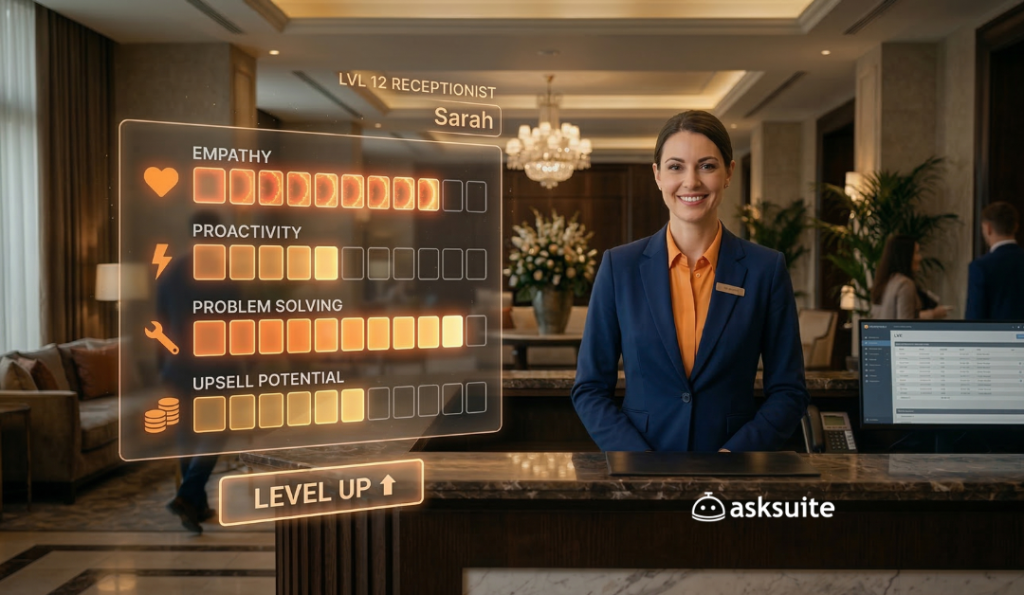
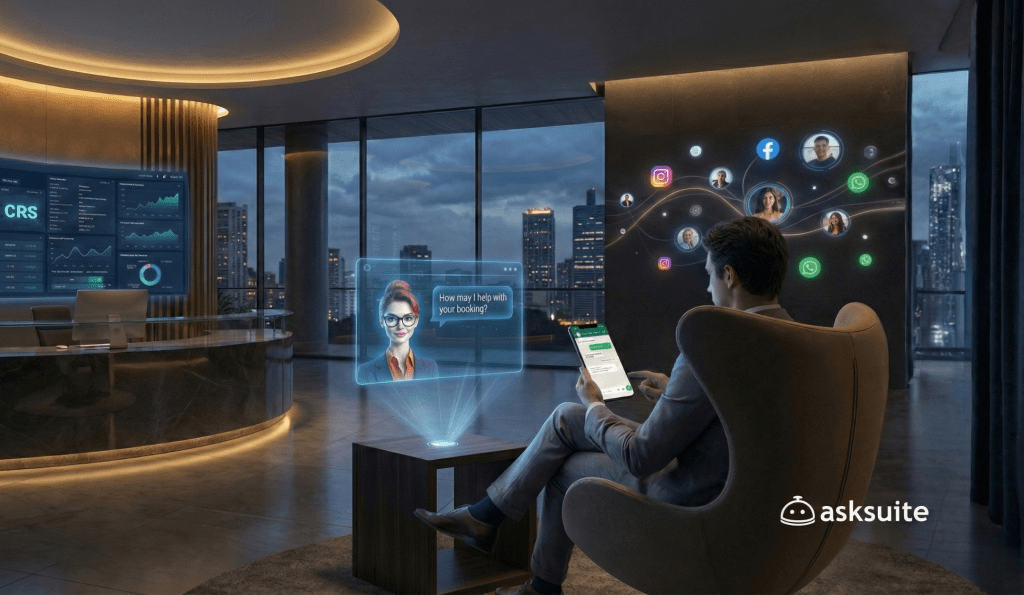
- Omnichannel + PMS: Context is king. When a traveler messages you on WhatsApp, an integrated system instantly pulls their profile from the PMS. Your agent immediately finds out whether this is a VIP guest, a repeat visitor, or a new lead, allowing them to tailor the conversation and upsell relevant services without asking “what is your reservation number?”.
- Zero Manual Entry: Automated tasks, like inputting guest data for check-in, happen in the background. The data goes from the interaction directly into the PMS fields, ensuring more accuracy and freeing up your staff’s time.
In 2026, integration is the backbone of profitable communication with potential guests.
WhatsApp first: Where travelers live, book, and pay
Travelers don’t want to jump between platforms. They want to ask questions, receive a quote, pay, and get their voucher all within the same chat window. The expectation is simple: everything happens in one place.
During high-demand events like the World Cup, speed decides who wins the booking. Travelers make fast decisions. They compare options in minutes, not days. Emails sit unopened while WhatsApp messages get read within seconds. Asynchronous communication loses ground to instant conversation.
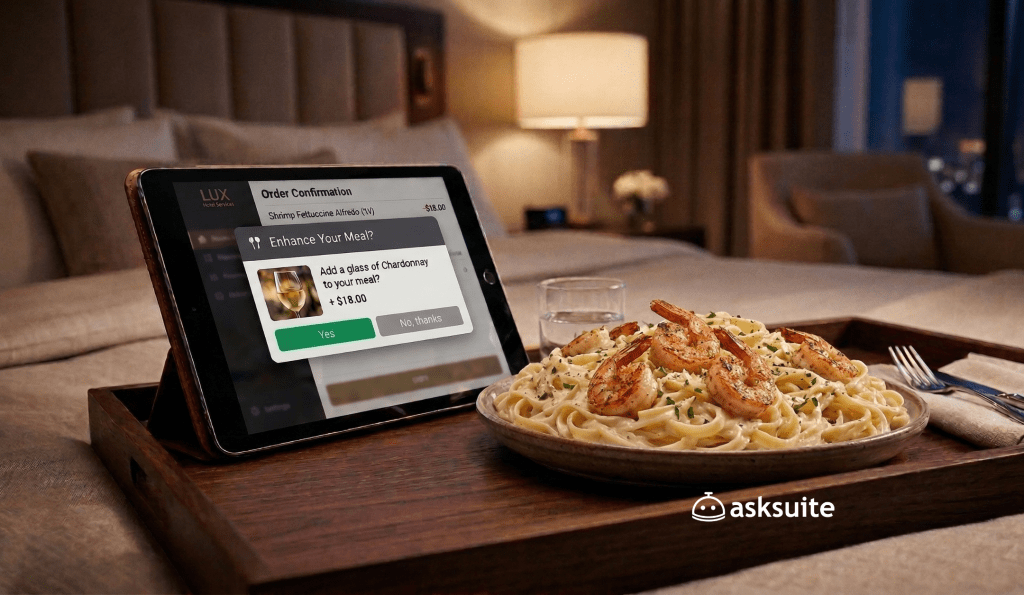
The real opportunity lies in conversational commerce during the stay. Once a guest checks in, automated messages can introduce available extras: dinner reservations, spa treatments, late check-out, room upgrades. No pushy sales calls. No printed flyers left on the nightstand. Just a simple, well-timed message that feels helpful rather than intrusive.
The guest sees the spa menu, taps a button, books a massage. Revenue increases without your team lifting a finger.
In 2026, the hotels that master WhatsApp as a full-funnel channel from first inquiry to post-stay upsell will capture more direct revenue than those still waiting for emails to be answered.
Invisible service and social search
Two emerging trends will shape hospitality beyond 2026.
- Invisible Service is technology that removes friction without being noticed. The traveler completes check-in via WhatsApp before arriving, walks into the hotel, and picks up the key. No lines. No forms. No waiting. The technology disappears and what remains is a seamless experience that feels effortless. The best tech is the one potential guests never see. They only feel the flow.
- Social Search is rewriting how travelers discover hotels. Gen Z and Millennials no longer start on Google. They scroll TikTok for inspiration, browse Instagram for visuals, and watch reviews from creators they trust. But when they’re ready to ask a question or book, they tap the link in bio and land on WhatsApp. The sales funnel now begins on social media and ends in your messaging channels.
Hotels that connect these dots have content that inspires, followed by instant conversations that convert, capturing the next generation of travelers before competitors even know they were looking.
Conclusion: The countdown has started
The trends are clear:
- Conversational AI is the new baseline;
- Agentic platforms automate tasks and relieve reservation agents;
- Integrated ecosystems eliminate double work;
- WhatsApp becomes the full-funnel channel;
- Invisible service sets the standard for guest experience.
The hotels that move now are already equipping their human agents withAI tools, connecting their systems, and positioning themselves to win the new wave of travelers. . The rest will miss out as they just watch it pass on by.