
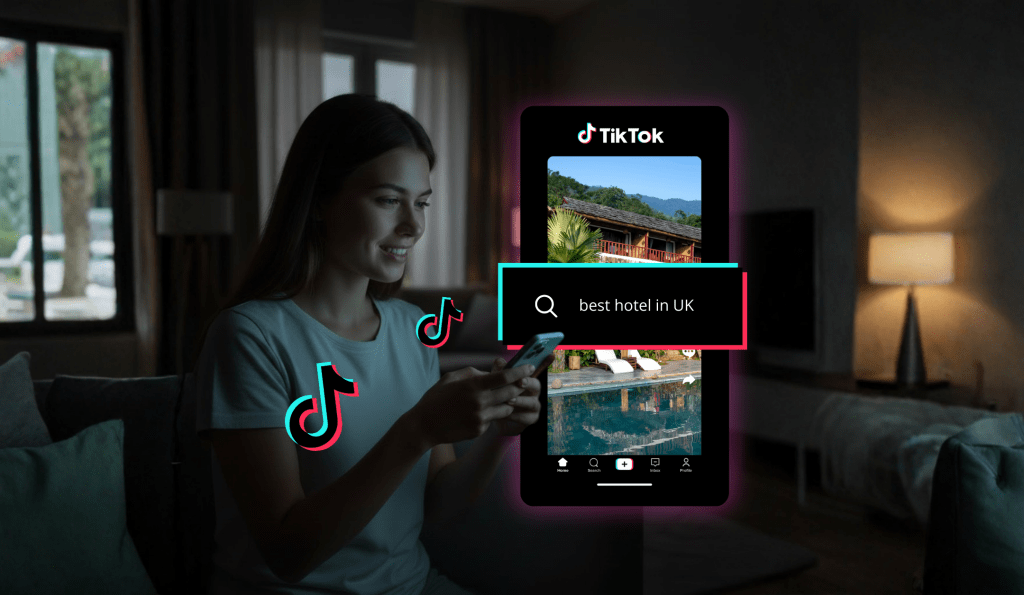
This social platform has become the go-to for the new generation to discover their next destination. For hotels, however, the real challenge is asserting commercial control over yet another communication channel.
For Gen Zers and Millennials, the search for a trip doesn’t start on Google, it’s on TikTok. They scroll through videos of rooftop pools and room tours before ever typing a query into a search engine. But here is the reality check: TikTok already generates real demand.
Asksuite’s internal research shows that 60% of hotels with TikTok Business receive inquiries daily or weekly. The demand is there, but the operation is broken. The question is no longer whether your hotel should be on TikTok. It’s whether your reservation team has the ability to manage it.
Here are the strategies to turn this “unbridled” channel into a controlled revenue stream.
1. TikTok SEO and authentic content
TikTok is a search engine now and must be treated like one.
When travelers type “hotel in Tulum” or “best boutique hotel in Lisbon,” TikTok scans captions, hashtags, and audio to deliver results. Your videos must be optimized to appear in these searches.
Write captions like you would in a blog post. Include the keywords travelers actually use: your city, your neighborhood, the experience they’re looking for. Skip the generic hashtags. Be specific. “Rooftop pool in Barcelona” beats “#travel #hotel #vacation” every time.
But here’s what many hoteliers get wrong: production value.
Polished, corporate-style videos don’t perform on TikTok. Users scroll past anything that feels like an ad. What works? Lo-fi content. Real moments captured on a smartphone, like a quick room tour with natural lighting, the bartender making a signature cocktail or a traveler’s genuine reaction at check-in.
The TikTok audience wants the truth, not a commercial. They want to see what staying at your hotel actually feels like unfiltered, unscripted, real.
The best part? This content costs nothing to produce. Your commercial team most likely already has everything they need in their pocket.
2. TikTok integrated in the omnichannel strategy
“Another channel for my team? They’re overwhelmed as it is!”
This is the fear. And the data validates the concern: 33% of hotels simply don’t answer TikTok messages because the channel is isolated on a marketing phone. Another 53% try to manage it manually via the app, where leads get lost, and there is no chat history.
The shift in 2026 is centralization. TikTok shouldn’t be a “marketing-only” channel. It is a sales channel. By integrating TikTok into your Omnichannel platform, the reservation team gains control. They receive TikTok DMs on the same screen as WhatsApp, email, and other social media.
Why this changes the game:
- Commercial Focus: Marketing creates the desire (videos), but the Reservation team captures the lead.
- Zero Noise: No more screenshots sent between the social media manager and the booking agents.
- Metrics: You finally have tracking. You know how many bookings started from a viral video.
3. The strategy: TikTok as the door, WhatsApp as the deal-making room
Here is a crucial insight from our research: 57% of hoteliers confirm that centralizing TikTok solves a real operational problem. Why? Because it facilitates the transition to efficient channels.
The goal isn’t to keep the potential guest chatting on TikTok, but to capture their interest and move them to a conversion-friendly environment. 47% of hotels already try to ask for the traveler’s WhatsApp manually. With an efficient integration, this bridge is seamless.
Unlike other channels where automation dominates, TikTok demands context. The strategy here is exclusively human service prioritized for quality.
- Entry: The traveler asks a question on a TikTok video.
- Capture: Reservation agents receive it in the Omnichannel.
- Bridge: The agent seamlessly guides the conversation to WhatsApp (where chat history is preserved) to send a quote or finalize the booking.
More than automating volume, your TikTok strategy must focus on professionalizing the conversation.
4. The power of User-Generated Content
Nothing sells a hotel better than real guests sharing their experience.
User-generated content (UGC) is the ultimate social proof. When a traveler sees someone like them: not a brand, not an influencer with a million followers posting about your pool, your breakfast, your room view, the trust is instant. It feels authentic because it is.
The strategy is simple: encourage guests to create content during their stay:
- A small sign at the front desk.
- A creative hashtag.
- A photo-worthy corner in the lobby.
- A gentle reminder at check-out.
These small nudges turn happy guests into real-life ambassadors. Then comes the easy part. Repost their content, with permission, on your hotel’s own TikTok account.
This is the cheapest and most effective way to fill your content calendar: just real moments from real people enjoying your hotel.
5. Strategic partnerships: Syncing creators with operations
A common scenario in hospitality: The marketing team hires an influencer or posts a viral video and the views explode. Suddenly, the reservation team is flooded with DMs asking about a specific “floating breakfast” or “romantic package,” but they have no idea what the offer is. Asksuite research highlights a critical pain point: noise between social media and the reservation team.
The strategy is to stop treating Influencer Marketing as just brand awareness and start facing it as a direct booking conversion channel.
Pro tips:
- Alignment: Before a creator posts, Marketing briefs the Reservation Team via the Omnichannel platform.
- The CTA: Instead of a generic “link in bio,” the Influencer’s Call-to-Action can be “Send a DM with the word PARIS for the offer.”
- The Capture: Because the channel is now integrated, the reservation team (not a social media professional) receives these high-intent leads instantly, with full context to close the sale.
This simple adjustment can transform a “viral mess” into a structured sales pipeline. You encourage volume (via creators) because now you finally have the oversight to handle it.
Conclusion: Volume, Order, Conversion
The formula is straightforward: TikTok generates demand, but historically, hotels lack control. In short:
- Visibility comes from authentic content and creators.
- Conversion comes from effective management and human connection.
By centralizing TikTok into your ecosystem, you stop treating it as a “social media task” and start using it as a “sales pipeline.” 33% of hotels are ignoring these potential guests due to lack of integration. Don’t be one of them.
Mastering TikTok is a gamechanger because it’s where the new generation searches visually. But, keep in mind that the revolution in how travelers find hotels doesn’t stop there.
While TikTok dominates “Social Search,” AI agents like ChatGPT and Perplexity are taking over “Generative Search.” Is your hotel ready to be recommended by them too?