4.9/5
4.9/5  HotelTechReport - with +970 verified reviews

Technology in hospitality spent an entire decade solving one problem: connecting systems that did not talk to each other. That problem is close to ending. But technology trends in hospitality are different, and the challenges are greater. For the first time since the booking engine was created, the person searching, comparing, and completing the booking may not be human.
In August 2026, Google confirmed that it is already testing agentic hotel booking within AI Mode, with the booking completed in the conversation itself. IDC projects that 30% of travel bookings will be executed by AI agents by 2030. Executed, not suggested. At the same time, a study published by Skift in June 2026 showed that only 11% of travel companies can currently sell to an AI agent.
This gap between infrastructure that is ready and a sector that is prepared is the real topic of this article. Below is what the last decade delivered, where hospitality stands in 2026, and seven changes that the data already allow us to anticipate, each with a time horizon and a confidence level.
A warning about forecasts in hotel technology
It is worth starting with what did not work. Trend lists published in 2022 put the metaverse, NFTs, and virtual reality tours forward as the future of hospitality. Four years later, almost none of that entered the operations of an average hotel. What did enter was much less photogenic: cloud PMS, WhatsApp, triage automation, and algorithmic pricing.
The lesson is useful. Hotel technology that sticks is the kind that reduces cost per transaction, response time, or dependence on an expensive channel. Technology that does not affect any of those three levers usually becomes a pilot and dies. That is the filter we apply to the projections in this article.
What the last decade actually solved
Over the last 10 years, hotel technology moved from isolated systems to connected operations, with PMS, CRM, channels, messaging, and data working together. The focus shifted from automating tasks to controlling the traveler journey.
| Phase | Period | What defined the stage |
| Back-office digitization | until the mid-2010s | on-premises systems, focus on recording and control |
| Cloud and integration | 2015 to 2019 | cloud PMS, open API, channel manager |
| Omnichannel communication | 2019 to 2022 | webchat, WhatsApp, channel centralization |
| Automation and applied AI | 2022 to 2026 | automatic triage, AI assistants, predictive RMS |
| Agentic layer | 2027 onward | agents that compare, decide, and transact |
The bottom line is clear. Cloud PMS, channel manager, CRM, omnichannel messaging, self check-in, and dashboards stopped being innovations in hospitality and became the baseline. A hotel without this foundation does not lose because it is not modern enough. It loses because of rework and slow response.
Digital transformation in hospitality also shifted the bottleneck. It moved out of the front desk and into the reservations center and distribution, where margin is still decided through manual work.
In Brazil, this asymmetry is structural: while chains have teams dedicated to performance and integrated systems, a large part of independent hotels still operate with separate tools for reservations, finance, operations, and marketing.
Where hospitality stands in 2026
The adoption of artificial intelligence in hospitality is no longer experimental. According to a global survey of more than 400 hospitality technology decision-makers published by Hospitality Net in March 2026, 71% of professionals say AI already has a significant or transformative impact on the sector, 85% expect to allocate at least 5% of the IT budget to AI tools, and 82% expect to expand use in the next year.
The money follows. A Hotel Dive report on the same study shows that more than half of hoteliers intend to allocate above 10% of the IT budget to AI, and that the main obstacles reported are data and privacy, integration barriers, lack of time for training, and lack of technical expertise.
In other words: the sector no longer has a persuasion problem. It has an implementation problem. That distinction defines everything that comes next.
The seven changes likely to define the next decade
1. Agentic booking changes who the customer of your website is
The infrastructure already exists. Google announced hospitality as a vertical within the Universal Commerce Protocol and confirmed to Skift in August 2026 that agentic booking is in limited testing in the United States within AI Mode, with Amadeus as the lodging partner and Booking among the first integrated platforms. In parallel, Sabre, PayPal, and MindTrip announced an end-to-end agentic pipeline in which search, selection, and payment are resolved within the conversation.
What changes in practice: your website stops being the destination and becomes a source. Whoever is comparing does not scroll the page, does not look at the lobby photo, and does not read the brand story. They check rates, availability, cancellation policy, and data consistency.
2. Machine readability becomes a prerequisite for visibility
An agent only recommends what it can read with confidence. If availability is not exposed in real time, if the room description varies across channels, or if the cancellation policy is ambiguous, the hotel is not rejected in the comparison. It never makes it into the comparison at all.
That is why the study cited by Skift, which found that only 11% of travel companies are ready to sell to an agent, is more relevant than any adoption forecast. The gap is not about intent. It is about structured data.
3. The margin battle moves earlier in the agentic layer
The question no one has answered yet is who keeps the commission when the agent closes the booking.
The strategic reading is this: acquisition cost by channel stops being a month-end spreadsheet and becomes a daily decision variable. Whoever does not know the true cost of each booking cannot negotiate at the next layer.
4. Continuous pricing replaces rate review
AI-powered RMS is no longer a large-chain item. 2026 market literature reports that most hoteliers already use AI for demand forecasting, and sector analyses associate the shift from rule-based pricing to predictive models with meaningful RevPAR gains in properties that make the transition with governance. The numbers vary widely across studies, which is expected in a base with uneven adoption.
The point is not the percentage. It is the frequency: the rate stops being decided in a weekly meeting and starts being recalculated continuously, with the revenue manager judging exceptions instead of line items.
5. Service stops being a queue and becomes orchestration
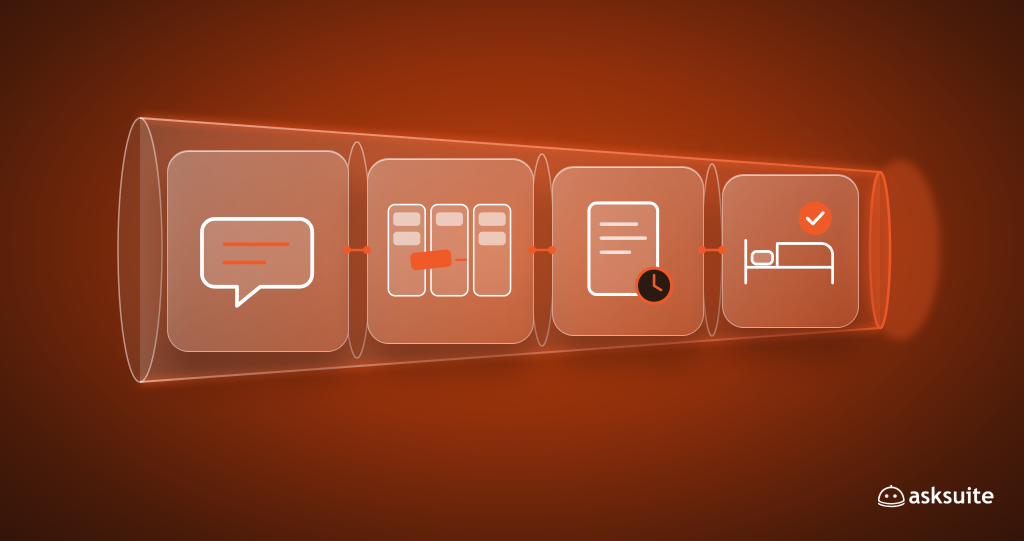
The natural evolution of omnichannel is not having more channels. It is having less intervention. The visible path goes from responding to executing: quoting, recording in the CRM, alerting the person responsible, following up on the deadline, and returning the case to a human when margin or exception is at stake. That is different from a chatbot.
| Generation | What it does | What still requires people |
| Rule-based chatbot | answers mapped questions | anything outside the script |
| AI assistant | interprets intent, consults knowledge base and availability | negotiation and commercial exceptions |
6. Trust, not capability, will be the bottleneck for adoption
Here lies the most interesting contradiction in the 2026 data. Analyses published this year indicate that the vast majority of travel executives intend to operate agentic AI at scale, while only about 2% of travelers say they are willing to delegate the full execution of a booking or change to an AI.
The reasonable projection is not linear adoption. It is segment-based adoption: corporate travel first, because company policy already works like a decision track, and leisure later, more slowly, with the agent playing the role of research and pre-selection before taking over payment.
7. Human contact remains a differentiator, not a cost
If the transaction layer becomes a commodity, what remains as differentiation shifts to what the agent cannot deliver: judgment, hospitality, exception handling, and relationship.
The counterintuitive projection is that well-executed automation will increase, not reduce, the value of human time in hospitality, a topic that connects with how productivity gains affect revenue in hospitality.
What to prioritize in the next 12 months
- Audit the readability of your data. Rate, availability, policy, and room description need to be consistent across the website, booking engine, OTAs, and public profiles.
- Calculate the true cost per channel. Commission, media, payment method, and team time. Without this, no distribution decision is possible.
- Measure response time by channel and by hour. This is the metric that speaks most directly to pre-booking conversion, the topic of 3 causes that affect online booking abandonment in hotels.
- Treat the knowledge base as an asset. What feeds your AI is the same thing that feeds the traveler’s AI.
- Define governance before autonomy. Who approves, what gets logged, where the AI stops, and the human takes over.
- Strengthen the direct channel now. It is the only margin variable the hotel controls on its own, and WhatsApp remains the highest-volume channel in Brazil and Latin America, as we show in how to serve customers via WhatsApp.
Where Asksuite fits in this scenario
Asksuite was built for hospitality, combining AI, omnichannel communication, and automation in the layer where demand arrives and the booking is decided.
- AI Reservation Assistant to serve travelers in multiple languages, understand intent, and qualify requests based on the hotel’s real knowledge.
- Omnichannel CRM to bring WhatsApp, webchat, email, social media, and OTA messages into a single queue, with history and owner defined.
- AskFlow Agents to automate tasks and communication with the guest during the stay and after the booking.
- WhatsApp Performance Suite to operate the channel with commercial metrics.
- Auto Kanban to turn the service queue into a booking funnel that organizes itself, with open proposals visible by stage and in real time.
- Atlas to measure the true origin of direct bookings and optimize paid media with confirmed revenue data.
With more than 5,500 hotels served and more than 500 integrations, the platform connects to the existing stack instead of requiring replacement. In a scenario where data consistency will decide visibility, centralizing channel and knowledge stops being an operational convenience and becomes a condition for competing.
Talk to Asksuite and see how a connected communication operation can reduce friction, organize demand, and support your team with AI built for hospitality.