4.9/5
4.9/5  HotelTechReport - with +970 verified reviews

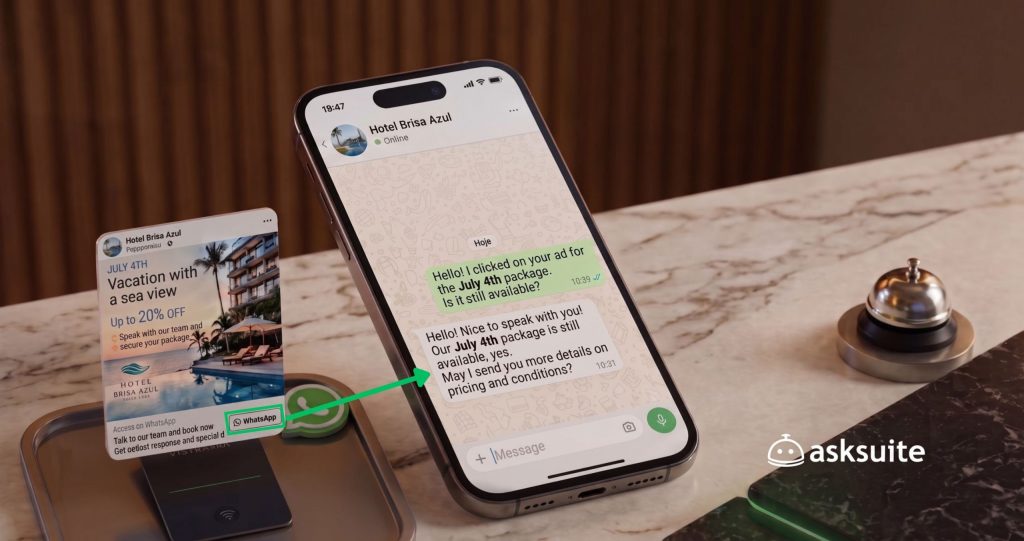
“Click to WhatsApp” ads in hospitality are an ad format that takes the traveler directly to the hotel’s WhatsApp. It reduces friction, speeds up qualification, and helps you better control service, funnel, and direct booking conversion.
In recent weeks, this format has become even more important. With the service message charges announced by Meta for October 1, 2026, replying to a traveler who arrived organically now comes at a cost. Conversations started by click to WhatsApp ads, on the other hand, get 72 hours of free messages (a period Meta calls the “Free Entry Point”). The source of the conversation now determines how much the service costs.
Today, 55% of Asksuite’s large WhatsApp Performance Suite customer base runs Click-to-WhatsApp campaigns, which suggests that this type of ad should work well. So if your hotel still drives paid traffic to a form, landing page, or OTA, you may be losing money, as well as response speed and conversion control.
In this article, you will understand what click to WhatsApp is, why this approach works in hospitality, how to build campaigns from scratch, which audiences to use, including remarketing, how to calculate ROAS in hotel operations, and how to measure the impact on service cost. You will also see how Meta’s new charges change the logic of each conversation.
What is a click to WhatsApp ad in hospitality?
Click to WhatsApp is an ad that runs on Meta channels, Facebook or Instagram, with a button that takes the traveler directly into a WhatsApp conversation with the hotel. In practice, the click opens the contact channel without requiring a form, page change, or waiting for an email.
In hospitality, this matters because the attention window is short: the traveler wants the rate, availability, location, children’s policy, parking, or payment method. The fewer steps between interest and response, the lower the friction.
Responding faster, with less friction and more funnel control, is what gives the channel operational value.
In simple terms, the format works like this:
- the hotel advertises in paid traffic on Meta (Instagram or Facebook)
- the traveler clicks the ad button for WhatsApp
- the conversation starts in WhatsApp, with a pre-filled message
- the team qualifies the lead and moves it toward the direct booking
This flow is different from sending the traveler to a website or form because it places the operation in an immediate conversation channel.
Where do the ads appear?
Click to WhatsApp is not a unique creative format. It uses the same formats as any Meta ad, single image, video, carousel, and collection, and runs in the usual placements: Facebook and Instagram feeds, stories, reels, and Marketplace.
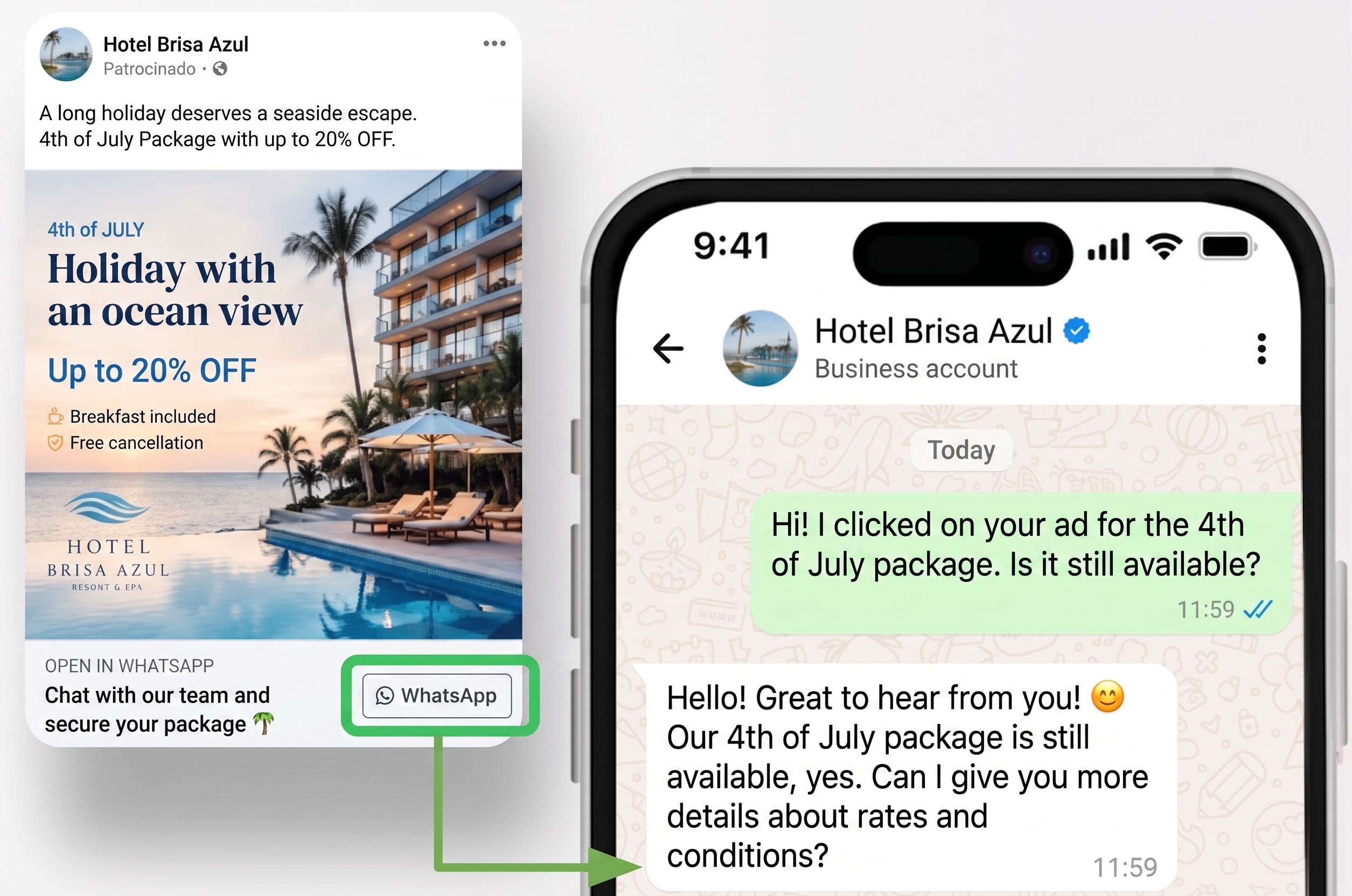
What changes is the destination. Instead of opening the browser, the click opens the WhatsApp app with a pre-filled message addressed to the hotel’s number.
This has a practical consequence that is often overlooked: you can reuse creatives that are already performing well in traffic campaigns. You do not need to produce new assets to test the format, just change the destination and the opening message.
Which hotels does the format work best for?
Click to WhatsApp depends on the traveler having the app installed and active. For customers in Brazil, Argentina, Mexico, Colombia, Chile, and across Latin America, using WhatsApp to communicate with businesses and make purchases is practically universal.
In markets where WhatsApp has low penetration, such as the United States, performance tends to be weak and other paths make more sense. If your hotel works with mixed markets, it is worth separating campaigns by origin or by a lookalike audience that has already interacted with your hotel through this channel.
Why sending the traveler to WhatsApp works better
1. Less friction
Sending the traveler to WhatsApp works because the conversation starts where intent is highest. The hotel captures the lead without requiring fields to be filled out, without lengthening the buying journey, and without pushing the decision into an asynchronous reply.
The comparison below shows the practical difference:
| Entry channel | Friction for the traveler | Response speed | Funnel control | Typical use |
| Form | High | Low | Medium | Passive lead capture |
| Landing page | Medium | Medium | Medium | Information and indirect conversion |
| Click to WhatsApp | Low | High | High | Direct booking and qualification |
The rule here is simple: if intent is high and the attention window is short, the conversation channel tends to perform better than a long route to service.
2. Meta’s new charges for WhatsApp service messages
As we mentioned in the introduction, Meta announced a change that alters the math for anyone not yet running campaigns of this type. We gathered all the details in the article about the new pricing for the WhatsApp Business API for hotels, but it is worth recapping the essentials here.
As of October 1, 2026, service messages sent by those using systems integrated with the official WhatsApp API will once again be charged.
The exception, and the opportunity for hotels, lies in conversations that begin with “click to WhatsApp” ads.
How the free window really works
This point deserves attention because the benefit is not automatic. According to the WhatsApp Business platform pricing documentation, the so-called free entry point window depends on two conditions:
- the traveler must start the conversation from a click to WhatsApp ad
- the hotel must reply within 24 hours of the traveler’s message
If both conditions are met, the window lasts 72 hours counted from the delivery of the hotel’s reply, not from the ad click. Within that period, any kind of message is free, including marketing templates, which are usually the most expensive.
What this changes in the hotel’s math
This means looking at “click to WhatsApp” as a channel that now brings together two advantages: it takes the traveler straight into the conversation and extends the reply window without charges.
Next, here is how to set up this type of campaign in practice.
How to set up a click to WhatsApp campaign the right way
A well-built click to WhatsApp campaign depends on a clear objective, the right audience, and an opening message prepared to qualify quickly. The ad should not generate clicks only. It needs to open a flow that takes the traveler to the booking with fewer steps.
The official guide to ads that direct to WhatsApp explains the basic campaign mechanism within the Meta ecosystem. What separates a useful campaign from an expensive one is the preparation of the conversation, creative, and targeting. That is what we will focus on here.
Before launching the campaign
Three things need to be settled before the first dollar is spent.
Verified account and number. The WhatsApp Business account must be connected to Business Manager and to the number that will receive the conversations. To operate at scale, the path is the official API, contracted through an approved provider. This is what allows you to distribute conversations among agents, automate triage, and measure results by campaign. If these terms still sound confusing, it is worth checking the hospitality technology glossary.
A practical note: use a dedicated commercial number. Migrating the same number the front desk uses on a cellphone to the API usually creates operational confusion, because the number no longer works in the regular app.
Did you know? Asksuite provides you with the entire lead management system and the most important tools for your day-to-day operations. However, the connection between LiveChat and Meta (WhatsApp) is handled by Gupshup, one of Meta’s largest WhatsApp API partners. This partnership is visible directly in your Business Portfolio. Under the “Partners” tab, you should find Gupshup, ODCEM Technologies, or Text Wave, all companies within the Gupshup group. It is very important to keep this connection active! If you have any questions regarding these partners, please contact our Support team directly.

Defined campaign objective. In Ads Manager, the most commonly used objective for this format is Engagement with WhatsApp destination, which optimizes for the volume of started conversations. If your hotel already has history and tracking configured, it is worth testing Leads or Sales, which optimize for quality rather than volume. Start with Engagement and move later when you have data.
Avoid the Traffic objective. It optimizes for link clicks, not conversation starts, which usually delivers more clicks and fewer real conversations.
Who responds and how fast. This is the point most hotels leave for later. If nobody knows who answers a conversation that arrives at 10 p.m. on a Saturday, the ad will only create an invisible queue.
Before launching the campaign, answer in writing: who handles business hours, who handles nights and weekends, what happens to a conversation that has no response within 30 minutes, and who follows up the next day.
On the Asksuite platform, in the AI Data Studio menu, under Tag Automation, you can create a series of rules to route and track these campaigns, including configuring who answers the user’s first question, the AI or your human agent.
1. Choose a specific offer
Do not advertise the hotel “as a whole.” Advertise a specific and clear offer: weekend, family rate, corporate package, long holiday, day use, ocean view. In hospitality, an overly broad offer creates curious clicks and weak leads.
A practical way to test this is to choose three occasions that already work well in your booking history and turn each one into a separate ad set. That way, you can discover which demand responds best to the format before scaling.
Examples of segmentation by hotel type:
| Hotel type | Offers that usually work |
| Leisure resort | Long holiday with all-inclusive, family package with one child free, vacation season |
| Urban hotel | Monthly corporate rate, cultural weekend, early check-in for guests arriving on early flights |
| Boutique inn | Two-night romantic getaway, anniversary package, high season with minimum stay |
| Beach hotel | Day use with pool, last-minute ocean-view deal, holiday with transfer included |
| Event hotel | Wedding block, group rate, congress accommodation |
A calendar tip: build the offer grid 60 to 90 days in advance, looking at periods of lower expected occupancy. The format performs well when the offer solves a real occupancy gap, not when it is generic. If seasonality is your main challenge, it is worth combining this grid with your annual hotel sales planning.
2. Audience targeting
If you do not have an email base, start with Advantage+ and well-structured creatives. In that case, the creative itself becomes part of the filtering because it attracts people who identify with the offer. This is also Meta’s initial recommendation for those who are starting in advertising.
If you already have at least 1,000 emails in your customer base, preferably personal emails, test 1% to 3% lookalike audiences.
It also makes sense to separate ad sets by dimension that changes service: language, origin region, or trip type. If the conversation will be answered by different people or in different languages, it deserves its own ad set.
Naming examples:
- Conjunto 1: BR | Lookalike 1% | Frequent travelers
- Conjunto 2: AR | Lookalike 2% | International travelers
- Conjunto 3: BR | Family leisure interest | Cold prospecting
One detail about breadth: conversation campaigns tend to respond well to broad audiences, because Meta’s optimization signal becomes stronger when there is a large pool of people likely to send a message. Piling on too many interests tends to increase cost per conversation without improving quality.
3. Start with remarketing
Cold prospecting is only half the strategy. In hospitality, the decision cycle involves comparing dates, rates, and competitors, and a large share of travelers who talk today only book weeks later. Remarketing is what recovers that part of the funnel.
The audiences that make the most sense for a hotel:
Those who chatted and did not book. This is the hottest audience there is. Export the list of contacts who started a conversation and did not convert, and upload it as a custom audience in Manager. It is worth segmenting by reason: those who asked for a quote and disappeared, those who thought it was expensive, those who did not have availability on the requested dates.
Those who visited the booking engine and did not complete it. With the pixel installed, you can create audiences by visit depth: those who viewed the rates page, those who reached the cart, those who abandoned at payment. Each one calls for a different offer.
Those who engaged with the profile. Engagement audience on Instagram and Facebook in the last 30, 90, or 180 days. It is colder than the previous ones, but it is usually cheaper than pure prospecting.
Those who watched the video. If you run video creative, create an audience of those who watched 75% or more. It works well as an intermediate layer between prospecting and warm remarketing.
Previous guests. PMS base, with consent, segmented by time since last stay and travel profile. It works especially well on holidays and stay anniversaries.
Three details that make a difference:
- Exclude those who already booked. Confirmed booking audiences need to be excluded from all prospecting campaigns. Without this, the hotel pays to impact people who are already guests.
- Adjust the window to the booking lead time. If your hotel’s average lead time is 20 days, a 180-day audience is too cold. Use 7, 15, and 30-day windows as separate layers and compare cost per conversation among them.
- Keep the lists updated. A custom audience uploaded manually does not update itself. Set a biweekly or monthly export routine, otherwise the audience ages and costs rise.
A simple structure to get started, with budget allocation:
| Layer | Audience | Offer | Suggested budget |
| Prospecting | Advantage+ or 1% to 3% lookalike | Main seasonal offer | 60% to 70% |
| Warm remarketing | 90-day engagement, 50% video | Social proof, differentiators, light urgency | 15% to 20% |
| Hot remarketing | Chatted and did not book, abandoned the engine | Specific condition, last chance, extra benefit | 15% to 20% |
4. Vary the creative by angle
With Meta’s algorithm, the creative also works as a filter, in addition to the previous targeting. Test different assets by pain point and motivation:
- benefit-focused video creative, with convenience and fast response
- convenience-focused image creative, with pool, breakfast, spa, or location
- financial creative in carousel format, with flexibility, savings, and perceived value
- occasion-based video creative, such as leisure, business, or family travel
What tends to work best in hospitality:
- show the room and common areas in motion, not just a static catalog photo
- make the condition explicit in the creative, dates, number of nights, what is included
- use the first second of the video to show the product, not the logo
- make it clear in the copy that the response comes by WhatsApp, so the click does not surprise anyone
What tends to waste budget:
- institutional creative without an offer, which generates curious clicks
- text that is too long on the image, which reduces delivery
- a promise the team cannot fulfill in the conversation, which raises cost without increasing conversion
It is worth running the ad in feed, stories, reels, and Marketplace and looking at cost per conversation in each placement before concentrating budget. Frequency above 3 or 4 in a small audience is a sign of creative fatigue, and cost per conversation starts rising before CTR drops.
How Asksuite helps your hotel maximize conversion rate and campaign efficiency?
How to set up campaigns in Asksuite, in AI Data Studio, in the Tag Automation menu:
- create tags for each WhatsApp campaign. This way your marketing team can filter in live chat and locate all conversations that came from campaigns and how they evolved.
- Conversation API: with Asksuite’s new conversation API, you can ask any AI in the market to analyze all the service details of each campaign, analyze the quality of the lead that arrives, where conversations are getting stuck, the main objections, etc.
What to measure to know whether the campaign is working
You measure click to WhatsApp by looking at the funnel, not just the click. What matters is how many conversations turned into qualified leads, how many quotes were sent, how many bookings came from each campaign, and which agent converted best.
One technical point that is often overlooked: each conversation started by an ad carries an origin identifier, which makes it possible to link that conversation to the specific ad that generated it. Without capturing this data, all conversations arrive the same in the inbox and campaign analysis becomes impossible.
Asksuite’s WhatsApp Performance Suite solution provides funnel and agent-performance dashboards with the volume of requests, quotes sent, bookings converted, and revenue generated by channel, campaign, and agent.
Without this reading, the hotel replies to messages but does not manage the operation. It is the same problem we described in the post about tools for hotel managers: without performance visibility, management becomes intuition.
The metrics that matter
| Metric | What it shows | What to watch |
| Clicks | Interest in the ad | CPC and frequency |
| Conversations started | Entry into WhatsApp | Cost per conversation |
| Time to first response | SLA and cost health | Percentage answered in less than 24h |
| Qualified leads | Traffic quality | Time to qualification |
| Quotes sent | Funnel progression | Volume per agent |
| Bookings closed | Commercial result | Conversion by campaign |
| Revenue per agent | Service efficiency | Performance difference |
| ROAS | Media investment return | Comparison with breakeven ROAS |
The good news is that you can track almost all the indicators above in the performance dashboard, in the Kanban view, and in the SLA dashboard.
If you are still building the operation’s indicator panel, start with the 6 main KPIs for sales and bookings in hospitality.
ROAS: what it is and how to calculate it in hospitality
ROAS stands for return on ad spend. It answers a simple question: for every dollar invested in media, how much revenue came back?
The formula is straightforward:
ROAS = revenue attributed to the campaign ÷ media investment
An example with hotel numbers:
- monthly investment: R$ 4,000
- conversations started: 200
- confirmed bookings: 25
- average booking value: R$ 1,100
- attributed revenue: 25 × R$ 1,100 = R$ 27,500
- ROAS: R$ 27,500 ÷ R$ 4,000 = 6.9
In other words, each real invested returned R$ 6.90 in lodging revenue.
Be careful with what goes into the calculation. ROAS measures revenue, not profit. It does not subtract commission, operating cost per night, booking team cost, or WhatsApp message cost. That is why it is useful for comparing campaigns with one another, but not for saying whether the operation is profitable.
Three adjustments that make the number more honest in hospitality:
- Subtract cancellations. Use net revenue after cancellations and no-shows, not gross revenue from confirmed bookings. In hotels with flexible policies, the difference is large.
- Consider the total stay value. A four-night booking with restaurant spend is worth more than a single night. If your PMS allows it, use total revenue per booking, not just the room night.
- Compare with the alternative channel cost. A booking coming from an OTA carries a 15% to 25% commission. A booking coming from a direct campaign carries media cost. Comparing the two side by side is more useful than looking at ROAS in isolation.
What is a good ROAS for a hotel?
The honest answer is: it depends on your margin. But there are two useful references.
The first is your breakeven ROAS. It is the point where the campaign pays for itself, and it is calculated like this:
ROAS breakeven = 1 ÷ contribution margin
If the contribution margin per night is 40%, breakeven ROAS is 2.5. Any result above that generates positive contribution. If the margin is 30%, breakeven rises to 3.3. This number is more important than any market average because it is the only one that speaks to your operation.
The second is market benchmarks, which serve as directional references. 2026 surveys for the travel and hospitality sector point to an average ROAS of around 3.6 in Meta campaigns and around 4 on average across platforms. Broader analyses across all sectors indicate an average of 4:1 in Meta for the travel and hospitality sector.
Two practical takeaways from this:
- A ROAS below 2 in a mature campaign usually indicates a problem with the offer, audience, or service, not the platform.
- A very high ROAS in a small campaign may be the effect of warm remarketing audiences. Always separate prospecting ROAS from remarketing ROAS, otherwise the latter masks the performance of the former.
An important caveat for hospitality: Meta does not see the booking, because it happens in the conversation and is recorded in the PMS or engine. Without sending that event back, the ROAS shown in Manager will be underestimated. That is why reconciliation between conversation, quote, and confirmed booking needs to be done with a solution that carries this data end to end.
That is exactly what Atlas, Asksuite’s new launch, will do for hospitality. Because your WhatsApp is native to Asksuite, the algorithm can send Meta AI exactly the confirmed and sold bookings, net of cancellations.
Want to learn more? Click here and ask for a demo!
How to read the numbers to decide quickly
- lots of clicks, few conversations started: problem with creative, targeting, or promise. The ad attracts, but the traveler gives up before sending the message
- lots of conversations, few quotes: qualification problem. The opening message is not filtering well
- lots of quotes, few bookings: problem with offer, SLA, or follow-up
- big difference between agents: process problem, not media problem
- first response above 24 hours in part of the conversations: service scale problem, and now also a cost problem
- good ROAS with low volume: likely remarketing carrying the result. Check whether prospecting supports the funnel
- cost per conversation rising with high frequency: creative fatigue. Replace the asset before changing the budget
This reading helps avoid wasted investment. If you want a simple rule, use this one. A campaign without funnel reading is media without management.
How the official API helps you scale with more control and less risk
The official WhatsApp API helps the hotel serve multiple users, maintain centralized history, funnel metrics, and compliance. This is different from operating with regular WhatsApp Business, which tends to limit scale, management, and visibility.
WhatsApp Business may be enough for a small operation, but it has clear limits for hotels, chains, and resorts. Asksuite’s Performance Suite organizes distribution, reports, automation, and agent-level tracking.
The main operational gains are these:
- multiple users on the same number
- centralized conversation history
- automatic request distribution
- performance dashboards by agent and campaign
- compliance and GDPR with better access control
- integration with CRM, PMS, and other systems
- omnichannel with preserved context
- very low risk of blocking, compared with WhatsApp Business
- CRM view to track your sales funnel and all opportunities
- hospitality-specialist AI to filter leads and ensure a fast, qualified first response
There is also a specific point about campaigns: tracking the source of the conversation works properly only in an official API environment. Without it, you can still run the ad, but you cannot separate which campaign generated which booking.
If you were thinking of looking for a solution that uses an unofficial API, know that operating through an unofficial API greatly increases the risk of the number being blocked, as well as violating the WhatsApp business messaging policy. For hospitality, this is a serious operational risk because it affects service, history, and continuity of demand generation.
Scaling with control requires structure, not improvisation. If the hotel wants to work with click to WhatsApp campaigns with operational predictability, the base needs to be an official API, history, and funnel management.
Common mistakes that make campaigns more expensive
- Launching the campaign before organizing service. The ad only brings forward the problem that already exists in the operation.
- Using the Traffic objective. It generates clicks, not conversations.
- Leaving the first reply for the next day. In addition to cooling the lead, you now lose the free window.
- Running one campaign for all markets and languages. This prevents reading results and creates a poorly routed queue.
- Not excluding those who already booked. The hotel pays to impact people who are already guests.
- Changing everything at once when results drop. You lose the ability to learn from the test.
- Measuring only the click. The click is the cheapest metric to improve and the least correlated with revenue.
- Not recording the source of the conversation. Without it, all campaign analysis becomes an estimate.
What Asksuite offers to optimize the results of click to WhatsApp campaigns
Asksuite brings together resources that help the hotel manage traveler service from these campaigns with more control, without turning WhatsApp into a disorganized counter. The focus is to centralize conversation, funnel reading, and automation in a single flow.
WhatsApp Performance Suite combines dashboards, auto Kanban, automatic distribution, follow-up with AskFlow Agents, and integration with Sophia AI.
In practical terms, this makes it possible to:
- track performance by campaign and agent
- centralize multiple attendants on the same number
- apply follow-up to open quotes
- preserve history across website, Instagram, and WhatsApp
- qualify travelers with AI before the human queue
- measure revenue by channel with more clarity
If your team already serves by WhatsApp, the next step is not to talk more. It is to organize better what is already happening today.
Frequently asked questions
What is a click to WhatsApp campaign in hospitality?
It is a campaign format that takes the traveler directly into the hotel’s WhatsApp conversation after clicking the ad or CTA. In hospitality, this reduces friction, speeds up response, and brings the lead closer to the direct booking.
Why take the traveler to WhatsApp instead of using a form?
Because WhatsApp opens the conversation in the channel where decisions happen faster. The hotel captures the lead without requiring form completion and starts qualification in a space with higher intent.
Do Meta’s new charges affect click to WhatsApp campaigns?
They affect the cost of replies within the 24-hour window in organic conversations. Conversations started by click to WhatsApp ads keep 72 hours of free messages, as long as the hotel replies within 24 hours.
Is the 72-hour free window automatic?
No. It only opens if the hotel replies within 24 hours of the traveler’s message, and the 72-hour count starts when that reply is delivered, not when the traveler clicks the ad.
Which campaign objective should I choose in Manager?
Engagement with WhatsApp destination is the most common starting point because it optimizes for started conversations. Leads and Sales make sense when the hotel already has history and tracking configured. Traffic is not recommended for this format.
Can I use remarketing in click to WhatsApp campaigns?
Yes, and it is recommended. The most used audiences are those who chatted and did not book, those who visited the booking engine without completing, those who engaged with the profile, and the base of previous guests. Remember to exclude those who already booked.
What is ROAS and how do I calculate it in my hotel?
ROAS is the revenue attributed to the campaign divided by media investment. If the hotel invested R$ 4,000 and generated R$ 27,500 in bookings, the ROAS was 6.9. To know whether that number is good, compare it with your breakeven ROAS, which is 1 divided by your contribution margin.
Is regular WhatsApp Business enough for a hotel?
It can work for a very small operation, but it usually limits multiple users, funnel metrics, automation, and campaign tracking. In hotels, chains, and resorts, this becomes an operational bottleneck. The essential care in WhatsApp service helps identify when the channel has become a bottleneck.
What should a hotel measure in click to WhatsApp campaigns?
Click, conversation started, time to first response, quote sent, booking closed, conversion rate by agent and by campaign, plus ROAS. Without these metrics, the hotel sees movement but not performance. It is worth cross-checking with the sales and booking KPIs.
Is it possible to know which agent converts best on WhatsApp?
Yes, as long as the operation uses a solution with an official API and performance dashboards by agent and campaign, such as the SLA dashboard.
How can I avoid wasting messages when the conversation starts on WhatsApp?
The path is to qualify faster, reply objectively, and automate follow-up on open proposals. This reduces unnecessary back-and-forth and improves the use of the free window.
Does click to WhatsApp work for any hotel?
If your property’s audience usually uses WhatsApp, the answer is yes! Since WhatsApp is a more intimate channel for people who already have a higher level of interest, your campaigns will usually perform better with a deeper-funnel audience, one that is further along in the buying journey. That is why starting with remarketing to those who visited your website or booking engine and did not buy can be a good strategy to get started.