4.9/5
4.9/5  HotelTechReport - with +970 verified reviews

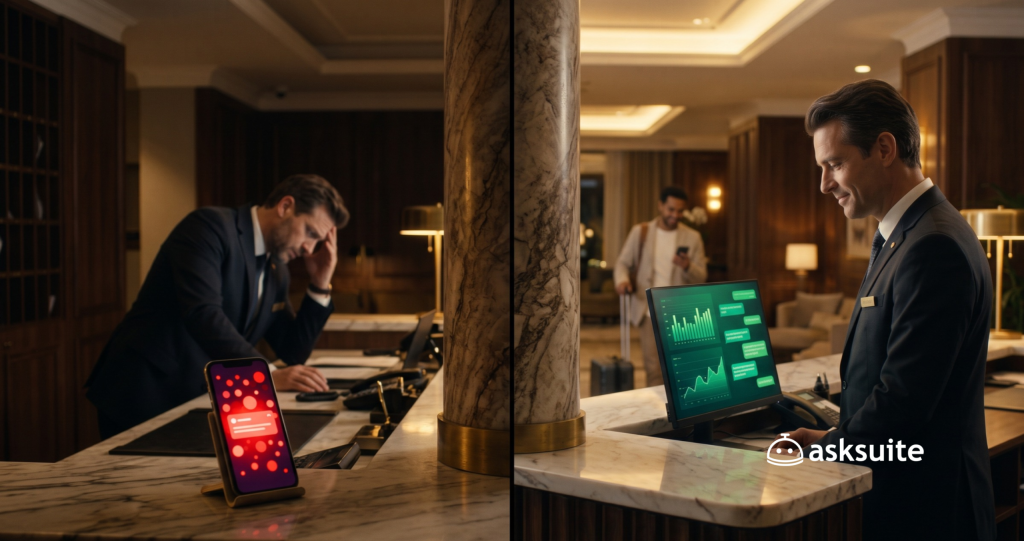
Hotel response time is the time between the traveler’s contact and your first useful reply. In hospitality, this directly affects conversion because the traveler compares options in parallel, switches channels effortlessly, and usually moves forward with whoever responds first.
If your hotel is slow to reply, the traveler does not stay still. They open another tab, request another quote, contact the OTA, or negotiate with a competitor that replied earlier. The intent window is short, and delay turns interest into abandonment.
In this article, you will understand how long the traveler is willing to wait, why speed matters for direct bookings, and how to measure and organize response time in hotel operations.
Why response time became a conversion factor
Response time in hospitality affects conversion because the traveler does not search sequentially. They compare several options at the same time while purchase intent is still hot. When you respond first, you create an attention advantage and increase the chance of guiding the conversation before the lead goes cold.
This is not just good service practice. It is a funnel stage. Salesforce shows in the State of the Connected Customer 2024 study that 78% of consumers expect consistency across channels and 64% expect a quick response, regardless of channel. In parallel, Harvard Business Review showed that leads contacted within 5 minutes are much more likely to move forward than slower contacts.
- The traveler compares rate, location, cancellation policy, and availability at the same time.
- The first reply captures attention before the lead moves to an OTA or competitor.
- Delay reduces the perception of priority and weakens the direct booking.
- The conversation cools down quickly when the reply does not arrive within the intent window.
Speed here is not courtesy. It is conversion protection.
How long the traveler waits before moving on to another option
The traveler waits less when the request is urgent and more when the channel is asynchronous. In quotes, near dates, groups, and promotional rates, minutes matter more than hours. Outside business hours, tolerance for waiting drops even further, because the competition remains available.
In the data from traveler service with Asksuite, analyzing 3.5 million travelers, 47% of contacts happen outside business hours. This explains why an urban hotel with a reduced night team usually loses more leads than the same hotel during the day.
| Request context | Typical tolerance | Operational risk |
| WhatsApp with a quote request | Very low | Quick abandonment if there is no almost immediate reply |
| Website chat | Very low | The traveler switches channels within minutes |
| Email with a non-urgent request | Medium | Delay beyond the same day reduces the chance of useful follow-up |
| Website form | Medium | Without a quick response, it becomes a cold lead |
| Outside business hours | Low to very low | Demand tends to move to an OTA or available competitor |
The practical logic is simple. WhatsApp and chat create an expectation of near immediacy. Email accepts more latency, but it does not tolerate excessive delay. If your SLA does not consider the traveler journey by channel and shift, you end up measuring service too much and intent too little.
In a resort, this difference shows up strongly in package requests, late check-out, and event group requests. In an urban hotel, it shows up in quotes for same-night stays, weekends, and last-minute rates. In both cases, the service window is short.
What the data shows: how hotel chains actually respond
Asksuite tested how EMEA hotel chains handle real traveler requests across email, WhatsApp, Facebook and Instagram. The gap between what travelers expect and what hotels deliver is wide:
– 60% of hotel chains did not answer booking quote requests sent by email.
– 80% of hotel chains do not use WhatsApp as a communication channel.
– 52% did not reply to messages sent to their Facebook inbox, even though all of them had a page.
– 60% did not reply to Instagram direct messages.
Even when hotels did reply, speed was far from what travelers expect:
| Channel | Replied | First response time |
| 40% | 70% in under 8h · 15% in under 24h · 5% after 24h | |
| 100% of hotels with an account | 70% in under 8h · 30% in under 24h | |
| 42% | 60% in under 8h · 20% in under 12h · 20% after 24h | |
| 40% | 75% in under 8h · 25% in under 12h |
On WhatsApp and chat, travelers expect a reply within minutes. A first response in “under 8 hours” is already too late for most quote requests.
Expectations by channel: WhatsApp, email, phone, and website
Each channel creates a different expectation. If you treat them all with the same SLA, your team replies out of sync with the traveler and loses continuity. The solution is to separate expectation, depth, and urgency by channel without breaking the conversation history.
If you still operate channels as silos, it is worth reviewing the content on multichannel and omnichannel in hospitality, because integration is exactly what prevents rework across WhatsApp, email, phone, and website forms.
| Channel | Traveler expectation | Tone and depth of reply | Risk if delayed |
| Almost immediate | Direct, objective, with a clear next step | The traveler opens another contact within minutes | |
| Phone | Instant | Complete, human, and with real-time negotiation | A missed call becomes a lost lead |
| Website chat | Very fast | Short, guided by FAQs | Channel switching and abandonment |
| Same day, ideally | More detailed, with context and proposal | The lead goes cold before follow-up | |
| Website form | Fast, with useful confirmation | Standardized and then personalized | The lead is left without a reply and migrates |
The key point is handoff. The traveler does not want to repeat the whole story every time they switch channels. When WhatsApp, email, and the reservations center do not share conversation history, you create silos and increase friction.
An omnichannel operation reduces this loss of context because it preserves the traveler journey. Multichannel without integration only multiplies entry points.
Want to see how hotel chains really perform when travelers reach out? Download Asksuite’s full study on reservation response performance in EMEA hotel chains and benchmark your hotel’s response time by channel.
What happens when the hotel replies too late
Replying too late costs more than the booking. It costs attention, context, and priority. When the lead goes cold, the team has to do more manual follow-up, the conversation becomes harder, and the team starts working reactively.
The practical effect usually appears in five areas:
- The traveler loses interest and stops replying.
- The chance of direct conversion drops because another option has already captured attention.
- The team spends more time recovering cold leads and less time qualifying warm leads.
- Backlog grows in the next shift because old messages accumulate.
- Demand moves to an OTA or competitor that replied first.
Harvard Business Review already showed that the first minutes are decisive for contacting and qualifying leads. In hospitality, this effect is even stronger because the traveler faces very visible rate competition and has little cost to switch channels.
The Asksuite content on online booking abandonment in hotels helps explain the friction: the more steps, the more doubt and the more waiting, the greater the chance of abandonment. If your reply arrives later, you enter the conversation when the decision is already out of your control.
How to measure whether your response time is hurting sales
You measure the problem by looking at the first response, not just message volume. High volume may look like productivity, but it can hide poor SLA, night-shift backlog, and useful replies that arrive too late. A hotel only improves what it measures.
If you want to structure this in your hotel, it is worth reviewing the KPIs for sales and reservations in hospitality guide, because it helps separate fast service from truly useful service.
Practical measurement checklist
- Time to first response by channel
- First response rate within SLA
- Time to useful response, not just the automatic response
- Percentage of leads answered outside business hours
- Backlog volume by shift
- Abandonment rate by channel
- Average follow-up time until closure or loss
Mini indicator table
| Indicator | What it shows | Where it usually gets worse |
| Time to first response | Speed of entering the conversation | Night and weekends |
| Useful response | Whether the traveler received real value | Asynchronous channels |
| SLA by channel | Whether the internal promise is met | When all channels follow the same queue |
| Backlog by shift | Accumulation of unhandled messages | Short shifts and reduced teams |
| Abandonment rate | Where the traveler disappears from the conversation | Before human follow-up |
A hotel with a reduced night team usually discovers that the biggest loss happens precisely when WhatsApp and phone have no coverage. In that case, the problem is not just capacity, it is shift design and priority. Measuring by channel and by time of day shows where the operation breaks down.
What to do to respond faster without increasing headcount
You respond faster without increasing headcount when you reduce repetition and organize priority. The gain comes from centralizing channels, automating simple questions, building a response library, and defining when the human team takes over the conversation.
The automated hospitality service and the content on how to use AI in hospitality show the operational logic: automation exists to filter the basics and free up the team for what requires negotiation, urgency, or a decision.
- Centralize WhatsApp, email, phone, and form submissions into a single flow.
- Create standard responses for frequent questions, such as check-in, cancellation policy, and parking.
- Define priority by intent and urgency, not just by arrival order.
- Automate initial triage outside working hours.
- Ensure human handoff when there is a request for rate, group, upgrade, or commercial condition.
- Review routing so hot leads do not get stuck in generic queues.
In practice, automation does not replace the team. It cuts repetitive tasks and opens space for hybrid service, with real-time replies on what matters and human continuity when the conversation needs to move forward. This distinction is what separates a lean operation from a confusing one.
Hospitality Net gathers recurring discussions about technology, distribution, and service in hospitality, and the most consistent point is this: automation works best when it improves triage, not when it tries to erase the role of the reservations team.
How this topic impacts direct bookings versus OTA
The impact appears when speed stops competing with the OTA. If the traveler gets a faster reply from Booking, Expedia, Airbnb, or a direct competitor, the decision may happen before you resume the conversation. Direct booking loses strength because convenience beat friction.
The relationship between speed and trust is direct. The traveler chooses the easiest, clearest, and fastest path. If your reply comes later, the intermediary channel seems less risky, even if the rate is similar.
According to the WTTC, distribution and digital experience remain central parts of competitiveness in the travel sector. In practice, this means your response speed enters the competition alongside rate, policy, and availability.
See the operational difference:
- Direct booking: depends on fast response, clarity, and less friction
- OTA: delivers instant confirmation and comparison, with less effort from the traveler
- Direct competitor: wins when it responds first and reduces doubts earlier
- Intermediary channel: reduces perceived risk because it concentrates the conversation in a familiar flow
The content on the importance of the online booking experience in hospitality helps close this reading. The response experience is part of the booking experience, and it weighs as much as the booking page itself.
Frequently asked questions
What is the ideal response time for a hotel?
There is no single number for all channels, but the practical rule is to respond as fast as possible. In WhatsApp and chat, the expectation is almost immediate. In email, tolerance is higher, but the reply still needs to arrive early enough to keep purchase intent alive.
Why does response time affect direct booking?
Because direct booking depends on keeping the traveler’s attention during comparison. If the hotel is slow, the traveler finds another option before closing the contact. This reduces the chance that you can guide the conversation all the way to the booking.
Does the traveler really expect a reply outside business hours?
Yes. In many cases, demand arrives outside working hours, especially through digital channels. If the hotel does not cover this period, a significant share of purchase intent moves to whoever is available first.
Which channels require the fastest response?
WhatsApp, website chat, and phone usually require the fastest response because the user expects immediate interaction. Email and forms allow a little more time, but they still depend on a useful reply as quickly as possible.
How can I reduce response time without hiring more people?
By centralizing channels, automating repeated questions, and creating clear priority rules. It also helps to use standard responses for frequent questions and automatic triage outside business hours, with handoff to the human team when needed.
What should I measure to know if my hotel is replying too slowly?
The ideal is to track first response rate, time to first response, SLA by channel, and the percentage of leads served outside working hours. These indicators show where the process gets stuck and when the traveler is abandoning the conversation.
Does replying fast solve the conversion drop on its own?
Not on its own. Speed helps a lot, but it works best when the reply is also clear, useful, and consistent across channels. If the process is fragmented, the hotel may reply quickly and still lose the lead because of lack of continuity.
Do you want to understand where your hotel loses replies and how to better organize communication with travelers? Get to know Asksuite and see how to centralize channels, automate repetitive tasks, and speed up service.