4.9/5
4.9/5  HotelTechReport - with +970 verified reviews

Most hotels are already on social media. The problem is that posting sporadically, without a clear strategy or consistent identity, generates work without reservations. A photo of the pool on Monday, a repost of a guest review on Friday, and silence for two weeks. That is not a strategy, it’s a presence that does not convert.
The hotels that use social media well do something different: they treat their profiles as a direct sales channel, not a digital bulletin board. They show up consistently, speak directly to the guest they want to attract, and make it easy for a follower to become a booking without ever going through an OTA.
This guide walks you through how to do exactly that, from choosing the right platforms and defining your brand voice, to ready-to-use content prompts and tactics that turn engagement into direct reservations.
How does social media influence hotel booking decisions?
Travel decisions are not made at the moment of booking, but rather weeks or months earlier, during moments of scrolling and saving and dreaming. A guest who books your hotel in June may have first seen your property in a reel back in March, saved it, returned to it twice, checked your feed, read the comments, and then searched for your website when they were ready to commit.
Social media is where the decision begins. Travelers across age groups use Instagram, TikTok, and Linkedin to collect ideas, compare properties, and validate their choices before they ever visit a hotel website.
A property that shows up consistently and visually in those moments of inspiration holds a decisive advantage over one that waits to be found.
Where should my hotel be on social media?
Not every platform deserves equal investment. The right choice depends on who your ideal guest is and what you are trying to achieve.
Instagram and TikTok for leisure and inspiration
These are the two most important platforms for hotels targeting travelers. Both are visual-first, reward consistent short-form video content, and have large, highly engaged travel communities.
Instagram works particularly well for properties with strong visual identity: design hotels, resorts, boutique properties, and any hotel with photogenic spaces or experiences. Reels, stories, and the feed work together to build aspiration and trust over time.
TikTok reaches a younger audience and rewards authenticity over polish. A 30-second video of a staff member showing a hidden corner of the property, or a guest’s genuine reaction at check-in, can outperform a professionally produced brand video on this platform.
For most hotels, the smartest starting point is Instagram. Once content production is consistent there, repurposing that content for TikTok requires minimal additional effort.
LinkedIn for corporate clients and events
Event planners, executive assistants, and procurement managers use LinkedIn to evaluate venues for conferences, retreats, team off-sites, and incentive travel. A hotel’s LinkedIn presence should speak to capacity, service standards, technical facilities, past event credentials, and group rates, a distinct voice from consumer-facing channels, but equally deliberate.
If your property has a dedicated event space or regularly hosts corporate groups, LinkedIn deserves consistent attention.
How do I build a social media strategy for my hotel?
A strategy is what separates a profile that posts randomly from one that builds toward a goal. Making three decisions before you publish a single post will shape everything that follows.
How do I define my hotel’s brand voice on social media?
Your brand voice is how your property sounds across every channel: The words you choose, the tone you use, the personality you project. It needs to be consistent whether you are writing a caption on Instagram, responding to a comment, replying to a DM, or answering a Google review.
A hotel that presents itself as warm and intimate on Instagram but formal and transactional in its email campaigns sends mixed signals that erode trust. Consistency, maintained over time, is what builds the kind of brand recognition that makes a guest choose your property over a competitor they found at the same price.
To define your brand voice, answer these three questions:
- If your hotel were a person, how would they speak? (Friendly and relaxed? Sophisticated and understated? Energetic and playful?)
- What three words should guests associate with the experience of staying at your hotel?
- What would your hotel never say or do on social media?
Write these down. Share them with everyone who manages or contributes to your social content.
How do I identify my ideal guest and create content for them?
A luxury resort targeting high-net-worth travelers needs a fundamentally different content strategy than a design hotel courting digital nomads, or a city property pursuing corporate groups. The content, the platforms, the tone, and the offers all follow from knowing who you are trying to reach.
Define your ideal guest profile: where are they from, what motivates their travel, what do they do on social media, and what kind of content stops their scroll. Then build your strategy around that profile, not around the platforms that happen to be trending:
- If you attract couples celebrating anniversaries, show romantic details: room setups, table arrangements, sunset moments.
- If you attract business travelers, show the workspace, the fast check-in, the quiet breakfast.
- If you attract families, show the pool, the activities, the ease of the experience.
The more specific your content is to your ideal guest, the more it will resonate and the more likely it is to reach similar people via algorithmic recommendations.
How often should a hotel post on social media?
Consistency matters more than frequency. A hotel that posts three times a week will build more trust and algorithmic momentum than one that posts daily for two weeks and then disappears for a month.
A sustainable starting point for most properties:
| Platform | Recommended frequency |
| Instagram Feed | 3 to 4 times per week |
| Instagram Stories | Daily, or at least 5 days per week |
| TikTok | 3 to 5 times per week |
| 2 to 3 times per week |
A simple monthly content calendar, even a spreadsheet with dates, content types, and captions drafted in advance, removes the daily pressure of deciding what to post and ensures the strategy stays on track during busy operational periods.
What type of content works best for hotel social media?
Short-form video (Reels and TikToks)
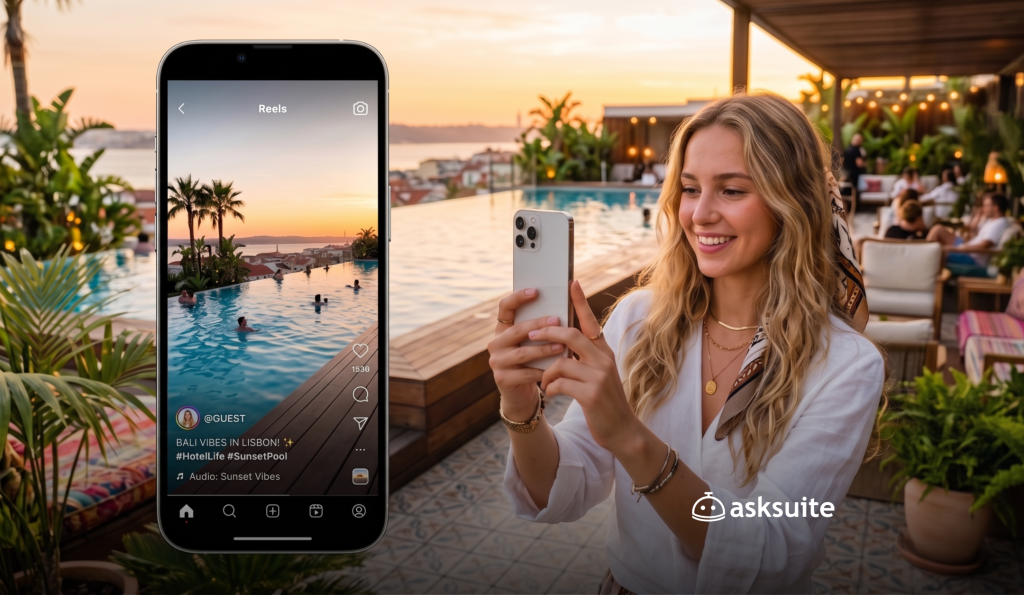
Short-form video is now the dominant content format for hotel marketing. Reels and TikToks consistently outperform static imagery in reach and engagement, not because they are newer, but because they demonstrate the guest experience in motion.
A 30-second reel showing the morning light in a suite, the sound of a poolside breakfast service, or a time-lapse of a sunset from the terrace communicates more than any photo. The goal is to capture and sell the feeling of being there.
Videos do not need to be professionally produced to perform well. Authentic, natural footage filmed on a smartphone often outshines polished brand content, especially on TikTok, where high production value can feel out of place.
User-generated content (how to get guests to post for you)
User-generated content (UGC) is the most credible marketing asset a hotel can acquire, and one of the least expensive. Travelers trust peer reviews and guest-created photos 88% more than content produced by the brand itself. When a guest posts a photograph from your property and tags the hotel, they are issuing a personal endorsement to their entire network.
To generate a consistent stream of UGC, create the following conditions:
- Design Instagrammable moments into the physical property: a signature wall, a distinctive breakfast plating, a welcome amenity that invites a photograph
- Display your branded hashtag visibly at check-in and in the room
- Send a post-stay email encouraging guests to share their experience and tag the hotel
- Feature guest content regularly on your feed and in your stories, as those who see themselves reposted are more likely to share again
A curated story highlight titled “Guest Moments” or a weekly UGC feature on the feed signals to potential guests: real people are staying here, enjoying this, and sharing it. That social validation accelerates booking decisions in ways that no polished brand campaign can replicate.
Local content (positioning the hotel as a destination guide)
Guests do not just choose a hotel, they choose a destination. A hotel that positions itself as an expert on the surrounding area adds value before the guest even arrives and earns organic reach from travelers researching the locale.
Neighborhood content ideas: the best hidden restaurants within walking distance, seasonal events nearby, a guide to the area from a staff member’s perspective, a partnership with a local experience provider.
Ready-to-use prompts to create hotel social media content
Copy the prompts below, fill in the brackets with your property’s details, and paste them directly into ChatGPT, Claude, or any AI writing tool. Each prompt is written to generate platform-ready content without requiring a marketing background.
Prompts for Reels and TikToks
Script for an experience video
“Write a short-form video script (maximum 30 seconds) for a reel or TikTok showcasing [specific space or moment: e.g. the rooftop pool at golden hour / the breakfast buffet setup / the arrival experience]. The tone should be [warm and inviting / aspirational / relaxed and authentic]. Include a suggested opening hook (the first 3 seconds), a brief visual sequence description, and a caption with a call to action inviting viewers to book directly. The hotel is called [Hotel Name], located in [City], and its main audience is [target guests: e.g. couples, business travelers, families].”
Script for a staff spotlight video
“Write a 20 to 30 second video script for a TikTok or reel where a hotel staff member shows their favorite hidden spot or detail inside the property. The hotel is [Hotel Name] in [City]. The staff member’s role is [role: e.g. concierge, chef, front desk]. The tone should be genuine and personal, not scripted or promotional. Include a suggested opening line for the staff member to say, a brief visual sequence, and a caption that brings the human touch to the brand.”
Script for a local guide video
“Write a short-form video script (30 seconds) for a reel where someone from [Hotel Name] in [City] shares their top 3 local recommendations for guests staying at the hotel. Include: one restaurant, one experience or attraction, and one practical tip most tourists miss. The tone should be like advice from a local friend, not a tourism brochure. End with a caption that positions the hotel as a destination guide and includes a call to action.”
AI tools to create the images and videos
Writing the script is just the first step. To produce the actual visual content, even without a production team, these tools handle the heavy lifting:
For videos with presenters and avatars
- HeyGen — Creates realistic videos with digital avatars that deliver your script on camera. Perfect for the staff spotlight format with zero filming required.
- Synthesia — Similar to HeyGen, with multilingual avatars. Great for hotels catering to international guests.
- Runway — For hotels that want to go further: generates video clips from still images or text descriptions.
Prompts for feed posts
Guest testimonial post
“Write an Instagram feed caption for [Hotel Name] in [City] featuring this guest review: ‘[paste the review here]’. The caption should open with the most impactful part of the review, briefly reinforce the experience described, and end with a call to action inviting followers to book directly. Keep the tone [warm / sophisticated / relaxed] and the length between 80 and 120 words. Include 3 to 5 relevant hashtags.”
Seasonal offer post
“Write an Instagram feed caption for [Hotel Name] in [City] promoting a [season: e.g. summer / winter holiday] offer. The promo is: [describe: e.g. stay 3 nights and get the 4th free / complimentary room upgrade for direct bookings in December]. The tone should be [aspirational / warm / playful]. Open with an evocative line about the season, describe the offer clearly, and end with a direct booking call to action. Maximum 100 words. Include 3 to 5 hashtags.”
Room or amenity feature post
“Write an Instagram feed caption for [Hotel Name] in [City] highlighting [specific room type or amenity: e.g. the junior suite with a terrace / the rooftop bar / the spa]. Focus on one detail that makes this space memorable rather than listing features. The tone should be [intimate / luxurious / relaxed]. End with an open question to encourage comments. Maximum 80 words. Include 3 relevant hashtags.”
For generating property images
- Midjourney — Produces high-quality images from text descriptions. Useful for visualizing scenarios or creating aspirational content.
- Adobe Firefly — Integrated into the Adobe ecosystem, it generates and edits images with greater control over style and brand consistency.
Prompts for LinkedIn
Corporate event capabilities post
“Write a LinkedIn post for [Hotel Name] in [City] aimed at event planners and corporate clients. The post should highlight the hotel’s event space and capabilities: [describe: e.g. capacity for up to 120 guests, AV equipment, private dining room, dedicated events coordinator]. Include one concrete example of a recent event hosted at the property — [describe briefly: e.g. a 2-day leadership retreat for a financial services team of 45]. End with a clear call to action for inquiries. Tone: professional but not stiff. Maximum 150 words.”
Corporate retreat value post
“Write a LinkedIn post for [Hotel Name] in [City] addressing the value of investing in a corporate retreat. The post should speak directly to HR managers, team leads, or executive assistants evaluating venues. Offer 3 specific reasons why off-site team gatherings drive business outcomes, then position the hotel as a venue that understands those needs. End with a low-friction call to action: an invitation to request a proposal or schedule a site visit. Tone: consultative and credible. Maximum 150 words.”
Social media marketing FAQs:
How many times a week should a hotel post on social media? Consistency matters more than volume. Three to four times per week on the feed, combined with daily Stories, is a sustainable and effective starting point for most properties.
Do I need a professional photographer to start? No. Smartphone footage shot in good natural light performs well, especially on TikTok and for stories, where authenticity outperforms polish. Professional photography is a valuable investment for hero images, but it is not a prerequisite to start.
Should I prioritize organic content or paid ads? Start with organic. Paid campaigns amplify what is already working, they underperform when the underlying content is weak or inconsistent. Once your posting is regular and your identity is clear, paid ads become a reliable way to reach new audiences.
How do I know if my social media strategy is actually working? Focus on reach, profile visits, link clicks, and direct bookings attributed to social media via UTM tracking. Follower count and likes are vanity metrics as they tell you very little about commercial performance.
Which platform should a hotel start with? Instagram, for most properties. It combines feed, stories, and reels in one place, has a large and active travel community, and shares an advertising infrastructure with Facebook. Once content production is consistent there, repurposing for TikTok requires minimal additional effort.
Building a social media presence that consistently drives bookings takes time, consistency, and a clear strategy. But the compound effect of showing up, week after week, with content that speaks directly to the guest you want to attract, is one of the most cost-effective marketing investments a hotel can make.
Social media is the storefront that attracts the guest. But for that guest to find you at the exact moment they are ready to book, your property also needs to be visible in local search. Read our complete guide to local SEO for hotels and learn how to make sure your property appears at the top when it matters most.