4.9/5
4.9/5  HotelTechReport - with +970 verified reviews


OTAs currently hold roughly 55% of the global hotel booking market and they charge between 15% and 25% in commissions for every reservation they generate (Prostay, 2026).
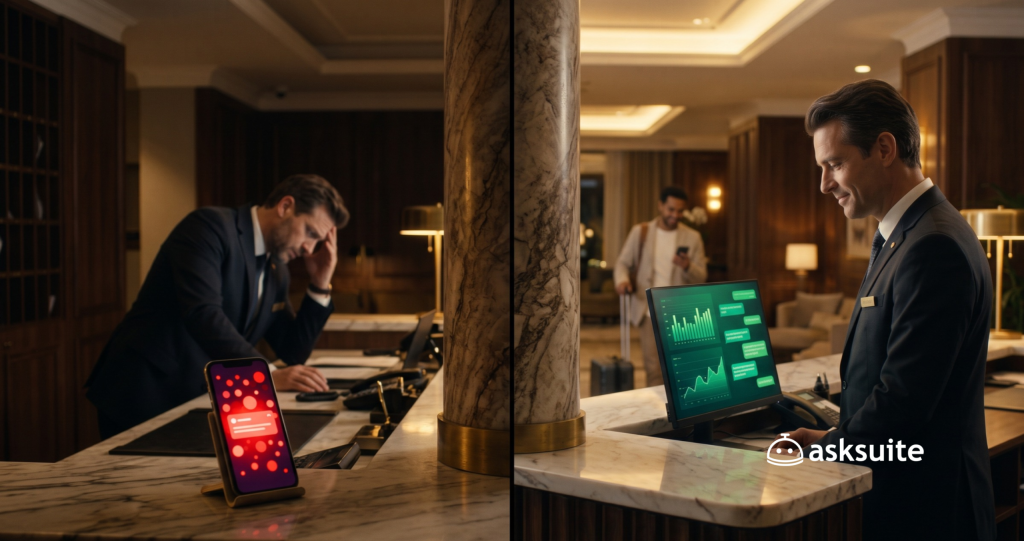
Reservations come in via WhatsApp, email, and phone calls. Typically these channels only work during staffed hours and break down entirely at night and on weekends. Without an automated direct channel, the OTA becomes the default.
A hotel booking engine changes that equation. It lets guests check availability, select a room, and pay securely, directly on your website 24/7.
This guide explains what a booking engine is, how it works, what it does to your revenue, why guests abandon bookings, and what to evaluate when choosing one for your property.
What is a hotel booking engine?
A booking engine is a software tool embedded in your hotel’s website that allows guests to check availability, select room types, and complete a reservation entirely on their own, in real time, without any human assistance required.
Think of it as your hotel’s own checkout system: always on, always accurate, and fully under your control.
How is a booking engine different from an OTA?
OTAs like Booking.com, Expedia, and Airbnb are essentially third-party marketplaces. They aggregate inventory from hundreds or thousands of properties and charge a commission for every reservation they generate. You gain distribution; you lose margin and guest ownership.
A booking engine is the opposite: it’s a proprietary tool that lives on your website, processes reservations on your behalf, and routes revenue directly to you. No intermediary, no commission cut, no dependency on an external platform’s algorithm to expose your property.
The OTA is a distribution channel. The booking engine is your direct sales infrastructure.
What does a booking engine actually do?
From the traveler’s perspective, the experience is simple:
- They visit your hotel’s website
- They enter travel dates and see real-time room availability
- They select a room type and add optional extras (breakfast, transfer, late checkout)
- They complete a secure payment
- They receive an automatic booking confirmation via email
No phone call. No waiting for a quote. No back-and-forth on WhatsApp. The entire transaction is self-service and it can happen at 2 AM just as easily as at 2 PM.
Key benefits of having your own booking engine
- Zero OTA commissions: Revenue from direct bookings goes entirely to your hotel
- 24/7 availability: Travelers can book whenever they want, not just during staffed hours
- Full pricing control: Set your own rates, run promotions, and create exclusive packages without platform restrictions
- First-party guest data: Every direct booking gives you the guest’s contact information, preferences, and history data that belongs to you and powers future marketing and loyalty efforts
How does a hotel booking engine work?
Understanding the mechanics helps you ask better questions and avoid buying a system that looks polished in a demo but breaks down under daily operating conditions.
The guest journey: from search to confirmation
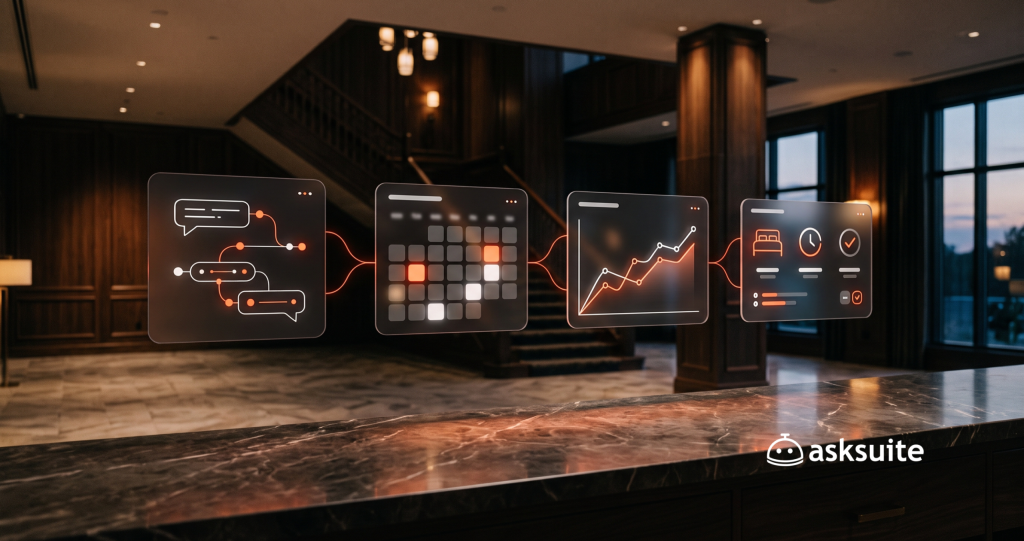
Here’s the full flow from a guest’s first click to their confirmation email:
Step 1 — Date search: The guest selects check-in and check-out dates. The booking engine queries your live inventory and returns available options instantly.
Step 2 — Room selection: Available room types are displayed with photos, descriptions, and rates. If you’ve set uprate plans (e.g., non-refundable vs. flexible), both options appear.
Step 3 — Upsell opportunities: Before checkout, the guest is offered relevant add-ons: breakfast, parking, airport transfer, early check-in. This is where incremental revenue is captured without any staff effort.
Step 4 — Secure payment: The guest enters payment details through a PCI DSS-compliant gateway. Options can include credit card, debit card, or third-party processors like Stripe or PayPal.
Step 5 — Automatic confirmation: The reservation is confirmed instantly, the guest receives an email, and your PMS is updated, all without human effort.
How the booking engine connects to your other systems
A booking engine doesn’t work in isolation. Its real value comes from integration with the rest of your hotel’s tech stack.
PMS (Property Management System): This is the most critical connection. When a booking engine is integrated with your PMS, every new reservation is automatically reflected in your availability calendar. This eliminates the risk of overbooking and removes the need for manual entry.
Channel Manager: The channel manager synchronizes your inventory and rates across all distribution channels (see FAQ section for more details). When a room is sold via any channel, that availability is removed everywhere else. Without this connection, a room booked on your website might still appear available on Booking.com.
Payment Gateway: A booking engine should integrate natively with major payment providers to ensure transactions are encrypted and compliant with card data security standards.
How can a booking engine increase my hotel’s revenue?
The financial case for a booking engine goes beyond “avoiding commissions.” Here’s a more complete picture.
How much do OTA commissions actually cost your hotel?
Let’s make this concrete. Suppose your hotel generates $50,000 in monthly reservation revenue. If 60% of that comes through OTAs charging an average platform fee of 18%, you’re paying approximately $5,400 per month, or $64,800 per year, just for the privilege of being listed.
Shift even 20% of that OTA volume to direct bookings, and you save over $12,000 annually.
For smaller properties with tighter margins, this math is even more impactful. A boutique hotel making $15,000/month in OTA revenue at 18% is paying $2,700/month to platforms that hold the guest relationship, control the data, and can change their algorithm or fee structure at any time.
Upselling and incremental revenue during the booking flow
The reservation process is one of the highest-intent moments in a traveler’s journey. They’ve already decided to stay at your property. They’re in a purchasing mindset.
A strategically configured booking engine takes advantage of this by presenting relevant add-ons before checkout: a breakfast package, an in-room upgrade, a late checkout, a spa credit, an airport transfer. These offers don’t require staff to pitch them. The system displays them automatically, the visitor accepts or declines, and the ticket value goes up.
Industry data consistently shows that travelers who book directly spend more per stay than those who book through OTAs. Upselling during the checkout process is the mechanism that makes this happen.
First-party data and guest loyalty
Here’s something OTAs will never offer you: ownership of your guests’ data.
When someone books through Booking.com, Booking.com owns the relationship. You get a name and a reservation number, but you don’t necessarily get the email address, the preference history, or the permission to market to them directly.
When a traveler books through your booking engine, you own everything. Their contact details, their stay history, their room preferences, their dietary notes, all of it is yours to use for personalization, loyalty programs, and direct re-marketing campaigns.
Over time, this data compounds. A customer who books directly once can be re-engaged with a targeted offer for their next anniversary trip, their preferred room type pre-selected, breakfast already included. That kind of customized experience is only possible through direct booking relationships.
Why do travelers abandon bookings and how do I stop it?
This is one of the most expensive problems in hotel distribution. Every abandoned booking represents a visitor who was already on your website, already interested, and left without converting. Understanding why this happens, and fixing it, is arguably more valuable than increasing website traffic.
Slow loading and too many steps
Length and friction are the primary drivers of abandonment. If your reservation process requires more than three steps, asks for information that isn’t strictly necessary at checkout, or takes more than a few seconds to load, you will lose sales.
The standard for conversion-optimized checkout is a maximum of three steps: availability search → room selection → payment. Anything beyond that introduces risk.
Mobile calibration is equally non-negotiable. More than 60% of hotel searches now happen on mobile devices, and a booking engine that wasn’t built for small screens will bleed conversions regardless of your hotel’s high quality. Touch-friendly buttons, auto-filling fields, and a checkout that doesn’t require zooming in are baseline must-haves, not premium features.
Unanswered questions during the booking process
This one is underestimated. A guest is mid-booking and has a simple question: Does the hotel accept pets? Is breakfast included in this rate? Is there parking on-site? They can’t find the answer on the page. So they pause. They open a new tab. They search for your hotel on TripAdvisor or Booking.com, where the answer is right there in the listing.
And they don’t come back.
This is where an AI-powered Reservation Assistant becomes a direct revenue tool, not just a customer service feature. Your checkout flow, always staffed. A chatbot trained on your property’s FAQs handles traveler questions instantly, around the clock — so hesitation doesn’t become abandonment. They get their answer, stay on the page, and complete the booking.
Without something like this in place, you’re essentially sending guests to OTA listings every time they have a question you haven’t pre-answered on your website.
Guests who quote and disappear
Many travelers go through the effort of selecting dates, choosing a room, and reaching the checkout page, then closes the browser and doesn’t return. Maybe they wanted to compare options. Maybe they got distracted. Maybe they needed to confirm with a travel partner. Whatever the reason, they’re gone.
Without a follow-up mechanism, that revenue goes to the OTA that retargets them first.
Automated follow-up flows change this dynamic. Tools like AskFlow identify travelers who started but didn’t end up booking and send personalized follow-up messages via WhatsApp, at the right time, with the right offer, to bring them back into the purchase funnel. It’s the hospitality equivalent of an abandoned cart email, applied to the highest-value transaction in your guest acquisition strategy.
Lack of trust signals at checkout
Ask yourself: would you enter your credit card details on an unfamiliar website with no visible security indicators?
Many hotel websites, especially independent properties, still ask guests to do exactly that. No visible SSL badge, no payment security icons, no guest reviews near the checkout, no clear cancellation policy before the final click.
Trust signals at checkout are not decorative. They’re conversion levers. Properties that display security certifications, show recent guest reviews near the payment step, and present cancellation terms clearly before the final confirmation see meaningfully lower abandonment rates at the most critical moment.
What should I look for when choosing a booking engine for my hotel?
With dozens of booking engine providers in the market, the decision can feel overwhelming. These criteria help separate systems that will genuinely perform from ones that look functional in a demo but fail in daily operation.
Mobile-first design
Not “mobile compatible”, mobile-first. There’s a meaningful difference. A mobile-first booking engine was built from the ground up for small screens and adapted upward to desktop. A mobile-compatible engine was built for the desktop and squeezed into a smaller layout.
Given that 60%+ of hotel searches happen on cell phones, and that mobile checkout has consistently lower conversion rates than desktop, a booking engine with a sub-standard mobile experience will cost you reservations every single day.
Ask vendors to demo the checkout flow on a phone, not a desktop browser window shrunk to simulate a cell phone. If the buttons are small, the text requires zooming, or the payment fields are awkward to fill, travelers keep looking.
PMS and channel manager integration
This is a deal-breaker criterion. A booking engine that isn’t natively integrated with your PMS is an operational liability. Without this connection, every direct booking requires manual entry into your property management system and availability discrepancies compound over time, creating not just overbooking risk but a breakdown in the operational trust your staff relies on.
When evaluating vendors, ask for a list of supported PMS integrations before discussing any other feature. If your PMS isn’t on the list, the conversation is over.
The same logic applies to channel manager integration. Your booking engine and your OTA channels need to share the same live inventory, otherwise you’re managing availability manually across multiple platforms, which is exactly the workflow you’re trying to escape.
Multi-language and multi-currency support
For hotels that serve international guests, language and currency barriers are among the most common reasons guests abandon the booking process. A traveler from Germany who lands on an English-only checkout, priced in a currency they can’t immediately understand, faces friction that simply shouldn’t exist nowadays.
Multi-language and multi-currency support should be considered mandatory for destination hotels, resort properties, and any place with meaningful international traffic. For urban business hotels with primarily domestic guests, this may be secondary, but it’s still worth evaluating for future-proofing.
Customization and brand consistency
Your booking engine is part of your hotel’s website. It should look like it belongs there.
A generic-looking checkout, with a third-party logo, a different color palette, and a visual language inconsistent with the rest of your site, tells guests they’ve left your property and entered an unfamiliar platform. That discontinuity introduces doubt at exactly the wrong moment.
Look for booking engines that allow full white-label customization: your logo, your brand colors, your typography. The transition from your website to the checkout page should be seamless enough that travelers don’t notice it happened.
Frequently Asked Questions About Hotel Booking Engines
What is the difference between a booking engine and a channel manager?
A booking engine handles reservations made directly through your hotel’s website. A channel manager distributes your inventory across multiple OTAs and keeps availability synchronized in real time. Both tools are part of the same ecosystem, but they serve different functions — one drives direct sales, the other manages third-party distribution.
Do I need a booking engine if I already use OTAs?
Yes, especially if you use OTAs. The more dependent you are on OTA distribution, the more urgent the case for a direct booking channel. A booking engine doesn’t replace OTA distribution; it gives you a proprietary channel that retains full margin and guest data ownership.
How much does a hotel booking engine cost?
Pricing varies widely by provider and property size. Models range from flat monthly subscriptions to commission-based pricing (typically 1–3% per transaction). For most independent properties, a flat-fee model is preferable to commission-based pricing since it makes costs predictable and doesn’t penalize you for growing direct revenue.
Can a small hotel or inn benefit from a booking engine?
Absolutely. Small properties often benefit most, because their margins are thinner and their capacity to absorb OTA commissions is more limited. A 20-room guesthouse losing 18% commission on every OTA booking has more to gain from shifting to direct reservations than a 200-room chain with negotiated lower rates.
How long does it take to implement a booking engine?
Implementation timelines vary by provider, but most modern booking engines can be set up and live within a few days to two weeks, assuming PMS integration is straightforward. Complex configurations like multi-property setups, custom integrations, full white-label customization may take longer.
Is a booking engine secure for online payments?
Any reputable booking engine should process payments through a PCI DSS-compliant gateway, which is the international standard for secure card data handling. Before selecting a provider, confirm their payment security certifications and ask which payment processors they integrate with natively.
The hotelier we described at the beginning of this guide: responding to WhatsApp quotes late at night, losing bookings after business hours, watching revenue flow to platforms that hold the guest relationship, isn’t dealing with a technology problem. In reality, there’s an issue with their strategy. The booking engine is the structural fix.
A booking engine performs best when it’s part of a connected system, integrated with your PMS, your channel manager, and the tools that help convert and retain guests. It’s the revenue engine at the center of a larger hospitality tech stack.
A booking engine is the conversion core of your hotel’s tech stack, but it only reaches its full potential when the right systems are built around it. Explore our complete guide to hotel management systems and learn how smart integration can transform your operation and profitability.