4.9/5
4.9/5  HotelTechReport - with +970 verified reviews

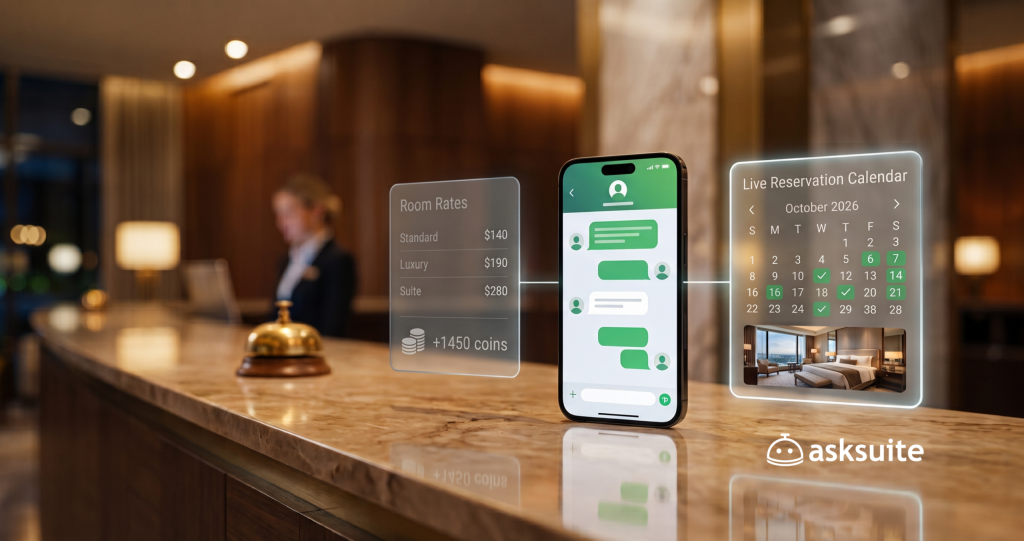
Optimizing revenue per booking is one of the greatest challenges hotels face. With hotel upselling, the practice of selling upgrades and higher-value services, you offer travelers a superior experience while simultaneously increasing your RevPAR (Revenue Per Available Room). The strategy works when the right offer meets the right traveler at the ideal moment.
The truth is that many hotels leave revenue on the table by not having a structured upselling program. According to Harvard Business Review, acquiring a new guest can cost between 5 and 25 times more than working with someone already at your property. The secret is not to sell more, but to enrich the experience of those who already trust you. A well-executed approach increases satisfaction, revenue, and loyalty.
This guide brings practical upselling techniques, examples for each traveler profile, and shows how to use data and technology to scale your revenue without overloading your front desk, concierge, or reservations team.
What is hotel upselling and why does it matter?
Hotel upselling is the technique of encouraging a traveler to purchase a product or service of a higher category than what they originally chose. In the hotel context, this typically means offering a room upgrade: from a Standard to a Deluxe, or from a city-view room to an ocean-view room. The goal is to increase the booking value while simultaneously improving the future guest’s experience.
In the hotel services industry, the difference between properties that grow and those that stagnate often lies in the ability to monetize what already exists intelligently. Well-executed upselling is a natural consequence of a service that anticipates the traveler’s needs, generating a perception of value far greater than the additional cost invested.
What is the difference between upselling and cross-selling in hotels?
While upselling focuses on an improved version of the same product (a superior room), cross-selling refers to the sale of complementary products or services. For example: adding breakfast to a stay, selling an airport transfer, scheduling a spa treatment, or offering room service items.
In practice, both strategies go hand in hand. A guest who accepts a room upgrade (upsell) may be more inclined to book a special dinner (cross-sell). Well-trained teams use both techniques in combination to maximize both revenue and guest satisfaction.
How much revenue can upselling actually generate?
The impact of upselling on revenue is direct and measurable. According to an analysis by Mirai based on real booking engine data, among guests who accepted an upselling offer, the average revenue increase per booking was 14.05%, meaning a $500 booking grew to approximately $570 without any additional acquisition cost.
The potential varies according to the property’s profile and service mix, but the result is clear: not having an upselling strategy means leaving money on the table.
How do you know which travelers to upsell and what to offer?
The foundation of upselling that converts is personalization and personalization depends on data. Trying to sell a romantic package to a business traveler not only fails, but can create a negative impression.
On the other hand, offering a late check-out to that same executive who has a late-night flight is a solution that generates both revenue and gratitude.
Hotels with a well-structured concierge service have a natural advantage, as preference gathering is already part of their process. The rule is simple: the more you know about the traveler before arrival, the more precise and relevant your offer will be.
How to collect traveler data before arrival
To personalize upselling offers, you need information. Integrate data collection smoothly into the traveler’s journey:
- In the booking engine: Include optional fields asking about the purpose of the trip (leisure, business), whether there is a special celebration, flight arrival and departure times, etc.
- In the confirmation email: Add a link to a short form where the traveler can indicate their preferences, such as pillow type, dietary restrictions, or interests (gastronomy, adventure, relaxation).
- In the PMS history: Returning travelers are a goldmine. Analyze previous stays to understand their consumption patterns and preferences, enabling hyper-personalized offers.
Good data management drives upselling as well as helps prevent guest complaints. When you already know what the future guest expects, the chances of frustration decrease dramatically.
Upselling by traveler profile
Once you have segmented your travelers, you can create specific offers that genuinely add value.
- Couples: Offer upgrades to rooms with panoramic views, romantic dinner packages, in-room breakfast, or experiences for two, such as a wine tasting or a private guided tour.
- Families with children: Suggest an upgrade to a connecting room or a suite with more space. Offer services such as early check-in to accommodate children’s routines, a special kids’ menu via room service, or supervised activity packages.
- Business travelers: Aim to provide efficiency and convenience. The best offers are upgrades to rooms with ergonomic workstations, late check-out, executive airport transfers, access to the business center, or meeting room passes.
- Solo travelers: Focus on experiences and safety. Offer a group city tour, tickets to local attractions, restaurant recommendations from the concierge, or an upgrade to a room on a quieter floor.
What are the best hotel upselling techniques?
With data and profiles in hand, it is time to apply techniques at the right touchpoints. The secret is to integrate the offer naturally into the traveler’s journey, turning the sale into a service.
1. Offer upgrades at check-in
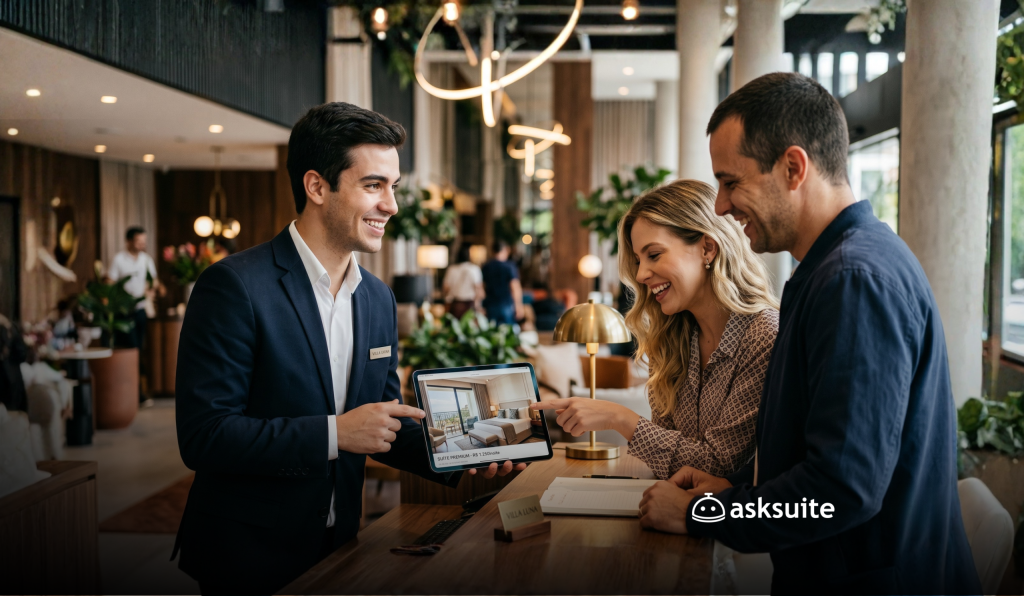
The check-in moment is ideal for upselling. The guest has already arrived, is excited about the trip, and is more receptive to suggestions that could improve their stay.
The front desk team should present the upgrade option subtly, highlighting direct benefits (“We have a suite with a balcony and ocean view available for a small additional charge. Would you like to take a look?”). This requires proper team training to avoid an aggressive approach.
2. Use the booking confirmation email
The booking confirmation email has one of the highest open rates of all communication channels, frequently surpassing 80%.
Adding a section with “Enhance Your Stay” linking to a room upgrade or breakfast add-on costs nothing and has a high conversion rate, as it captures the traveler at the peak of their engagement.
3. Add upsell options directly in the booking engine
During the online booking process, the traveler is actively making purchasing decisions. This is the perfect moment to offer additional services (cross-selling) such as breakfast, travel insurance, early check-in, or even room service items to be delivered upon arrival. Automation like this increases the average booking value without any effort from your team.
4. Send a pre-arrival message with personalized offers
A WhatsApp message or email, sent 24 to 48 hours before arrival, is extremely effective. Use the data you collected to personalize the offer. For example: “Hi, [Guest Name]. We noticed your arrival is tomorrow. How about starting your trip in a more relaxed way with our early check-in service?” It is also the ideal moment for the concierge to suggest and schedule local experiences.
5. Invest in team upselling training
No technique works without a prepared team. An upselling training program should go beyond memorizing scripts. Include role-playing of real situations and teach the team to “read” the guest and identify opportunities genuinely.
A well-trained team not only sells more but also improves the guest experience and, consequently, reduces negative reviews.
6. Turn room service into an upselling opportunity
Room service is frequently underutilized as an upselling tool. When receiving an order by phone, app, or QR code, the team can be trained to suggest complementary items.
If a guest orders a burger, suggest a side of specialty fries or a local craft beer that pairs well with the dish. Small add-ons significantly increase the final order value.
7. Create packages instead of isolated add-ons
Packages carry a higher value perception than the same items sold separately. Instead of selling just a room upgrade and a dinner, create a “Romantic Package” that includes the upgrade, a candlelit dinner, sparkling wine in the room, and late check-out. This simplifies the guest’s decision and increases the total sale value.
8. Use partnerships with local businesses
Expand your offer portfolio at no fixed cost by establishing partnerships with top restaurants, tour operators, spas, and local producers in your area. Your concierge becomes a curator of authentic experiences, extending everything from cooking classes and wine tastings to exclusive boat trips. These experiences have strong appeal, especially for international travelers.
9. Create a commission program for your team
To keep the team motivated, a commission program on upsell sales is the most effective tool. The program needs to be simple, transparent, and with clear goals.
When combined with quality training, the financial incentive ensures that your front desk and reservation team is constantly seeking opportunities to delight guests and increase revenue.
When is the right moment to upsell a guest?
Timing is just as crucial as the offer itself. Trying to sell an upgrade at the wrong moment can create friction and even dissatisfaction if the guest feels pressured. At the right moment, the same offer is perceived as a high-value service. Upselling should accompany the guest’s journey in a contextual way.
The upselling timeline: from booking to check-out
Map the touchpoints to optimize your offers:
- During booking: In the booking engine, offer add-ons such as breakfast, insurance, or transfers (cross-selling).
- Post-confirmation email: The first major moment for room upselling and special packages.
- Pre-arrival (48h before): Automated and personalized message with offers based on the traveler’s profile. A key moment for the concierge to act.
- Check-in: The best opportunity for in-person room upselling, carried out by the front desk team, offering immediate benefits.
- During the stay: Ongoing opportunities through room service, the spa, and activity and experience suggestions from the concierge.
- Pre-check-out: Late check-out offer, sale of hotel shop products, or enrollment in the loyalty program with an immediate benefit.
Manually managing personalized offers for hundreds of guests can be complex. Hotel communication and automation tools centralize guest data, automate message delivery at the right moments, and allow your team to focus on providing exceptional service rather than getting lost in operational tasks.
Hotel upselling FAQs
What is the difference between upselling and cross-selling in hotels? Upselling is offering a better version of the same product, such as a room upgrade. Cross-selling is selling a complementary product or service, such as breakfast, a spa treatment, or a transfer. Both techniques aim to increase revenue per booking and enhance the guest experience.
What is the best moment to upsell a guest? The best moments are those where the guest is most engaged: in the booking confirmation email, in a pre-arrival message (48h before), and during the in-person check-in. During the stay, opportunities arise through room service and concierge services.
How do you upsell without generating guest complaints? The key is personalization and relevance. Use traveler data to offer something that genuinely improves their stay, rather than pushing random products. The approach should always be consultative and focused on the benefits for the guest, not on the sale.
Can small hotels benefit from an upselling program? Yes, greatly. Small or boutique hotels often have a closer relationship with their guests, which facilitates personalization. Focusing on a few high-value items, such as an upgrade to the best suite or partnerships with exclusive local experiences, can have a significant impact on total revenue with low investment.
Increased revenue per booking with the right tools
Implementing an effective upselling and cross-selling strategy requires more than a well-trained team. You need the right tools to collect data, automate communication, and deliver the right offer at the exact right moment without overloading your operation.
Schedule a demo and discover how our platform can help your hotel automate the sending of personalized offers and increase your revenue, while your team focuses on what it does best: delighting your guests.