4.9/5
4.9/5  HotelTechReport - with +970 verified reviews

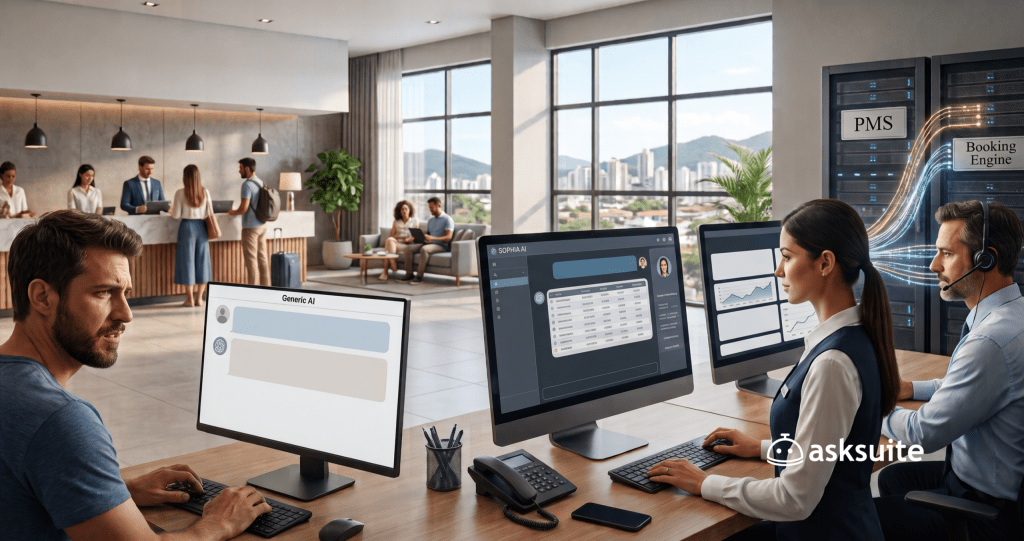
The race to adopt artificial intelligence is real, but choosing the wrong tool can create more problems than solutions. Implementing a generic AI in a hotel operation is like giving a subway map to a ship captain: the tool is intelligent, but the context is completely wrong. Understanding that AI in hospitality is already a reality is the first step, but you need to go further.
This article will detail the 5 crucial differences between a hospitality AI specialist and a generic AI. The goal is to provide a clear framework for choosing the technology that truly boosts your direct bookings and your team’s efficiency, evaluating context, integrations, data, team support, and revenue impact.
The illusion of generic AI: a shortcut that comes at a high cost in bookings and reputation
Generic AIs, such as chatbots based only on ChatGPT, can answer general questions, but they fail at what matters most for a hotel: they do not check real time availability, they do not create accurate quotes, and they do not understand the nuances of rates, packages, and seasons. This gap results in vague answers and lost travelers.
A “generic AI” in the context of hotel service is essentially a large language model (LLM) that was trained on the entire internet, but not on your hotel’s operational data. It is connected to a service channel, such as a webchat, to answer questions based on an FAQ document that you provide.
The result is a dead end for the traveler. When a potential guest asks, “How much does a room for two people cost at Christmas?”, the generic AI responds with a frustrating message such as: “For quotes and availability, please contact our reservations team.” The buying journey is interrupted, and the traveler will look for a competitor that offers an instant answer.
This model also runs the risk of providing outdated information. Cancellation policies, pet rules, or restaurant opening hours change. If the AI’s training document is not manually updated every time something changes, it will provide incorrect information, creating reputation issues.
According to a 2024 Deloitte report, personalization is a decisive factor, and modern travelers expect brands to understand their specific needs, something a generic AI cannot deliver.
Difference 1: Hospitality context vs. general knowledge
A hospitality AI platform is pre trained with millions of real interactions between travelers and hotels. It does not need to learn from scratch what “late check out” means or the subtle difference between an “ocean view room” and an “oceanfront room.” This built in context is its greatest asset.
Understanding hospitality context in practice means that the AI understands:
Seasonality: It knows that the price of a room in January is different from the price in May and that holidays have special rates.
Policies and restrictions: It understands and communicates complex rules such as a minimum stay of 3 nights during New Year’s Eve, pet policies, or specific check in and check out times.
Traveler intent: When someone asks, “Do you have activities for children?”, the AI not only confirms, but can also proactively suggest a family room category or a school holiday package that includes children’s activities.
Difference 2: Native integrations with PMS and Booking Engine
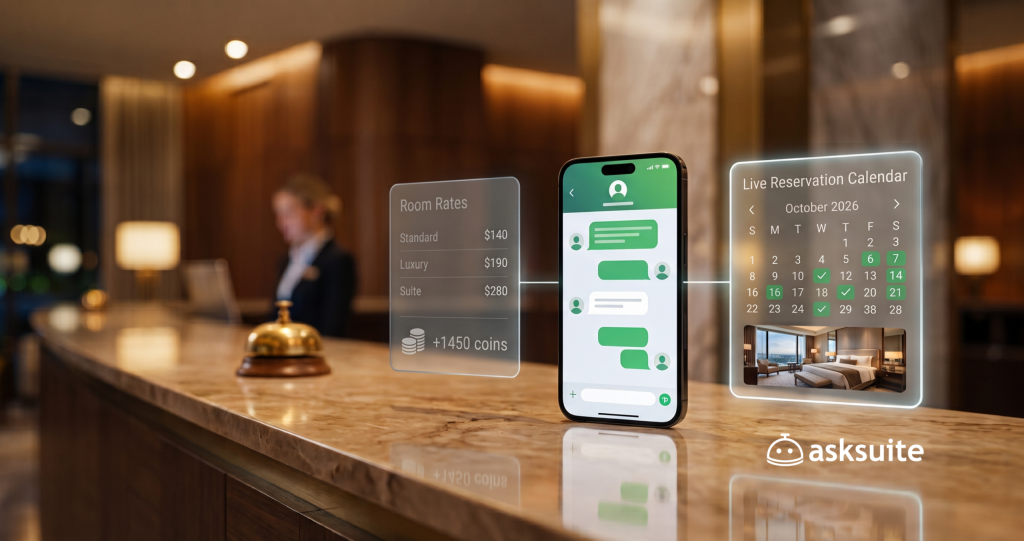
The biggest differentiator of a hospitality AI is its direct integrations with the PMS and the Booking Engine. This allows the AI to check real time availability, calculate exact prices considering dynamic rates and packages, and send a direct booking link so the traveler can complete the purchase.
Without an integration with your PMS and Booking Engine, a service AI is just a glorified FAQ. It is the connection with the hotel’s core systems that transforms a virtual assistant into a powerful automated salesperson.
Direct integrations allow a hospitality AI specialist to perform crucial tasks that a generic AI cannot:
- Real Time Quotes: When it receives a quote request for specific dates and number of guests, the AI checks inventory and rates directly in your PMS or Booking Engine. In seconds, it responds to the traveler with available room categories, exact prices for the requested period, photos, and a booking link, 24 hours a day, 7 days a week.
- Abandoned Booking Recovery: An integrated AI agent can identify when a traveler starts the booking process in the Booking Engine but does not complete it. With this information, it is possible to trigger a proactive follow up flow to understand the reason and help the traveler complete the purchase.
- Sales Process Automation: A hotel sales AI does not just provide information, it guides the traveler. After presenting the quote, it can send the correct booking link, apply a discount coupon when applicable, and guide the user to the payment page, completing the sales cycle autonomously.
The impact on the team is immediate. Reservation agents are freed from the manual, repetitive, and time consuming task of preparing quotes one by one. This allows them to focus their time and talent on complex negotiations, such as group sales, corporate events, or VIP guests, which generate much greater value for the hotel.
Difference 3: Focus on revenue metrics, not just service metrics
The success of a generic AI is measured by call center metrics, such as “questions answered,” “first response time,” or “deflection rate” (how many conversations did not require a human). For hotel management, these are vanity metrics. They do not pay the bills.
What really matters to a reservations manager or a general manager are business and revenue metrics. A hospitality AI specialist is built with this focus from the beginning. Its dashboard does not only show conversation volume, but also the direct impact on sales.
A robust hospitality AI platform offers a dashboard with essential sales and booking KPIs, such as:
- Conversion rate from conversation to booking.
- Total revenue generated by the AI assistant.
- Number of automated quotes sent.
- Performance by channel (WhatsApp, Instagram, Webchat, Email).
- Revenue generated by each human agent.
This data enables strategic decision making. You can analyze which marketing campaign is generating the most qualified leads on WhatsApp, which digital channel has the highest conversion rate, or which reservation agent performs best in closing complex sales. It is a shift from volume based management to results based management.
Difference 4: The copilot for the human team
Contrary to the fear that technology will replace people, a hospitality AI works as a copilot for the reservations team. It does not replace agents, it empowers them to work more strategically and productively.
The ideal workflow is orchestrated by the AI. It works as an intelligent front line filter, automating between 80% and 90% of repetitive questions, such as quotes for future dates, breakfast questions, or power outlet voltage.
When a negotiation requires human intelligence, such as a wedding group request, a long stay reservation with a negotiated rate, or a special request from a loyal guest, the AI transfers the conversation to a human agent. This handoff is intelligent: the agent receives not only the notification, but also the complete conversation history, the initial quote already prepared by the AI, and the traveler’s information.
The agent does not start from scratch. They already have the complete context of the traveler’s needs and can intervene strategically to add value, negotiate, and close the sale. The AI prepares the opportunity so the human salesperson can shine, focusing on transforming customer service into a powerful sales channel.
Comparison table: Hospitality AI vs. Generic AI
The difference in revenue generation capability becomes clear when comparing the features of a specialist solution with a generic one.
| Feature | Hospitality AI Specialist | Generic AI (ChatGPT Wrapper) |
| Real time price quotes | ✅ Yes (via PMS/Booking Engine) | ❌ No |
| Availability check | ✅ Yes | ❌ No |
| Direct booking link | ✅ Yes | ❌ No |
| Understanding of packages and promotions | ✅ Yes | ⚠️ Partial (only if documented) |
| Conversion and revenue analytics | ✅ Yes | ❌ No |
| Intelligent handoff to the team | ✅ Yes (with complete context) | ⚠️ Partial (notification only) |
| Centralized omnichannel operation | ✅ Yes | ❌ No |
Checklist: How to evaluate an AI solution for your hotel
When talking to technology providers, use this list of questions to ensure that the chosen solution truly meets the needs of your hotel operation and is not just a generic chatbot with new packaging.
- [ ] Does the solution integrate natively with my PMS and Booking Engine? Which ones?
- [ ] Can the AI provide a complete quote (price, availability, room photos) in real time without requiring a human?
- [ ] How does the platform measure success? By service volume or by revenue generated?
- [ ] Can the AI manage conversations across multiple channels (WhatsApp, Instagram, Webchat, Email) in a single interface, creating an effective omnichannel strategy?
- [ ] How does the handoff to a human agent work? Is the complete conversation history preserved?
- [ ] What type of sales and productivity insights and reports does the platform provide?
- [ ] Can the AI understand and automatically apply restriction policies such as minimum stay requirements or package rate conditions?
Choosing the right technology is one of the main trends shaping travel and can be the difference between leading the market in direct bookings or falling behind, losing travelers to more efficient competitors. Do not settle for generic answers.
Frequently Asked Questions
Q: What is the main difference between a hospitality AI and ChatGPT?
A: The main difference is integration and context. A hospitality AI, such as Asksuite’s Sophia AI, connects to the hotel’s PMS and Booking Engine to provide real time prices and availability, while ChatGPT provides generic responses without access to these systems.
Q: Is hospitality AI too expensive for a small hotel?
A: The investment varies, but the focus should be on ROI. A specialist AI pays for itself by increasing direct bookings, which have higher margins due to the greater profitability of direct reservations, while also optimizing the team’s time. A hospitality AI platform such as Asksuite offers plans for hotels of different sizes.
Q: Is implementing hospitality AI complicated?
A: No. Hospitality specialists such as Asksuite have implementation teams that handle the setup and integration with the hotel’s existing systems. The process is designed to be fast and fully supported.
Q: Will AI replace my reservations team?
A: No, it will empower them. AI works as a reservation assistant that serves guests 24/7 when your team is unavailable, and also as a copilot by automating 80% to 90% of repetitive tasks and qualifying leads. This frees your team to focus on strategic, high value negotiations, increasing productivity and job satisfaction.
Q: Can AI perform upselling and cross selling?
A: Yes. A hospitality AI can be configured to offer additional services, such as airport transfers, special dinners, or room upgrades after confirming a reservation. It can also do this with guests during their stay through automated communication workflows.