4.9/5
4.9/5  HotelTechReport - with +970 verified reviews


Meta has changed how the WhatsApp Business API is billed. Since October 1, 2026, replies that were previously free within the 24-hour window have become chargeable for businesses using the channel.
This is an important change that deserves attention. In this article, we’ll explain all the options available to Asksuite customers.
Since Meta’s announcement on July 1, the Asksuite Product team has been working intensively to minimize the impact of these changes, introducing optimizations for both AI-powered conversations and human agents.
This article also serves as an FAQ, directly explaining what has changed, what is now paid, what remains free, which features have been released to reduce the impact, and which channel-use strategies can help lower costs and optimize results.
What has Meta changed?
Meta has started charging for service messages on the WhatsApp Business API — that is, messages your hotel sends in response to customers.
Messages sent by customers to the hotel remain free. The charge applies to replies.
These messages were charged in the past, until the end of 2024, and became chargeable again on October 1, 2026. Utility templates sent within the 24-hour window are also now charged.
What is a service message?
A service message is any message the hotel sends in response to a traveler’s interaction, whether by text, audio, or image, without using a template. These messages are charged even within the 24-hour customer service window, which opens whenever a traveler starts or replies to a WhatsApp conversation.
- 1 image sent = 1 service message
- 1 image with text = 1 service message
The image below clarifies which messages incur charges. In the example shown, there are 2 service messages.
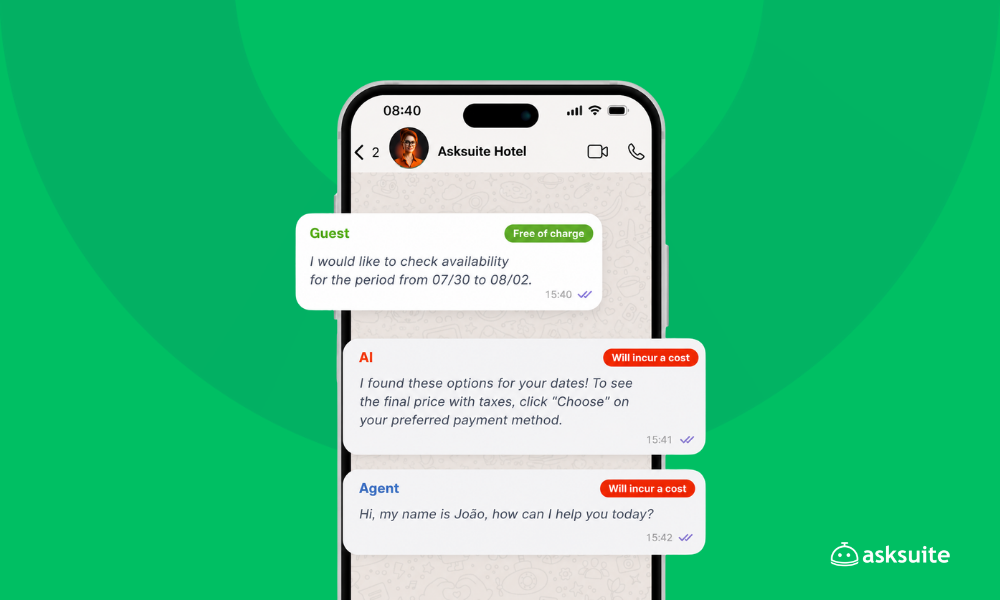
The number of characters or words in a message does not change its classification or its cost.
Does it matter whether the reply comes from a human or from AI?
It makes no difference. Billing doesn’t look at who wrote the message, whether AI or a human agent. The cost is the same per message.
Which messages will NOT be charged?
There are 3 situations where no extra charges apply:
- The first exception occurs when the customer sends a message from a Meta “click to WhatsApp” ad or from call-to-action buttons on Facebook or Instagram pages. In these cases, messages within the following 72 hours are not charged. This same rule already applies to HSM messages, which in these cases also carry no extra cost.
- Every message the traveler sends. In other words, when your hotel receives a message from a traveler, there is no cost.
- According to Meta, the same type of message will never be charged twice. Therefore, template-based messages, such as HSM and Utility, will not also be charged as a service message.
- Example: if your hotel sent an HSM to open a conversation, that same message will not additionally be counted as a service message.
Does the 24-hour window no longer exist?
No. The window remains unchanged, as does the requirement to use templates after 24 hours without a message from the customer. What changes is that free-form replies sent within the window are no longer free.
What has Asksuite done to minimize the cost impact for customers?
Some customers may experience only a minor cost impact, while others may see a greater one. The good news is that there are strategic alternatives and Asksuite product features that can help minimize this effect.
Asksuite’s Product team began working immediately after Meta’s announcement on July 1, 2026, to give customers as many options as possible.
The team’s initial approach was straightforward: since each message now has a cost, AI and human responses need to be combined where possible to convey the same information more efficiently.
Product optimizations
All the features listed below are free and already available, enabled by default for all customers.
The good news is that the initial optimizations described below are already delivering average savings equivalent to 40% of the new cost for customers.
1. Economy mode for human agents
Many agents reply to customers by breaking their answer into several messages. That’s exactly what we’re going to avoid with economy reply mode, condensing messages and images before they are sent.
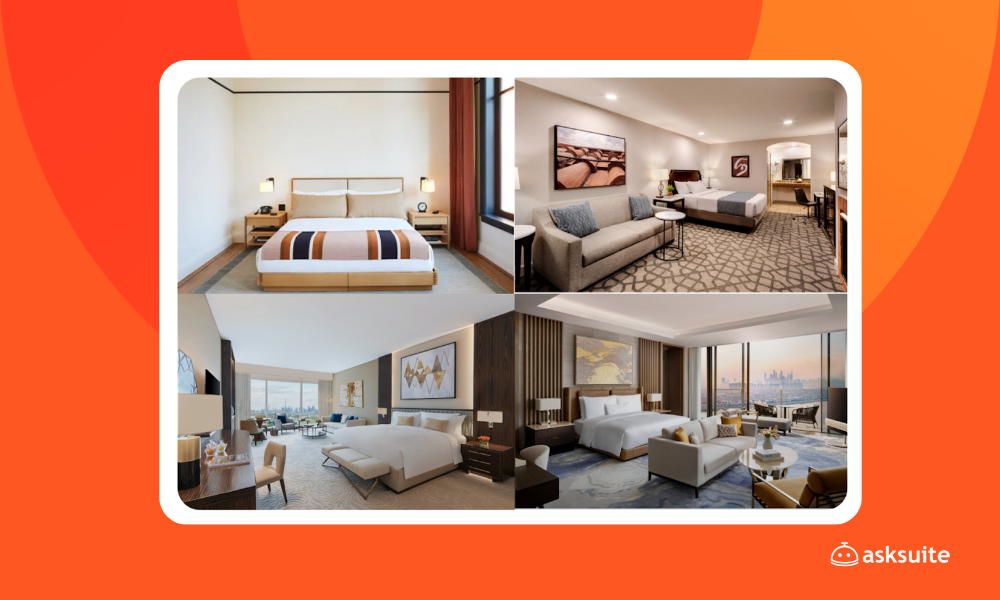
a) Image aggregator: If you need to send 4 breakfast images, the image aggregator turns those 4 images into just 1, reducing 4 messages sent to 1.
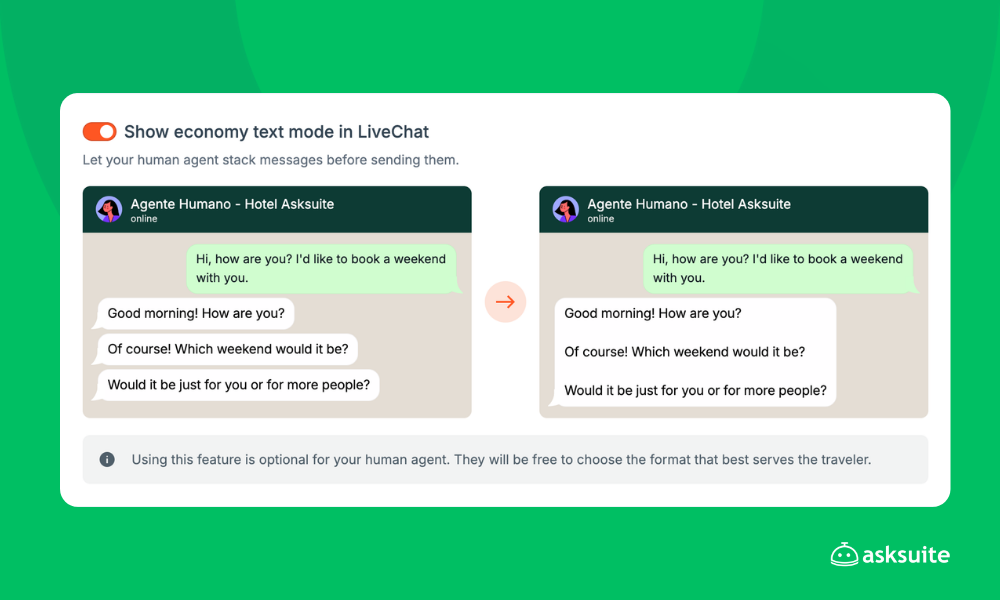
b) Message aggregator: With economy mode active by default, the system aggregates your team’s replies so they can be sent as a single message. You won’t have to worry about training your team for this; the Asksuite system will be your monitor throughout the process.
In the example below, 3 messages become just 1, and the agent can choose whether to send it with spacing between sentences or not:
c) Economic Mode always on: Until now, agents could enable or disable Economic Mode at any time. Managers can now lock the setting so that it stays enabled at all times, directly from the WhatsApp Optimizations screen. When the lock is on, agents cannot disable it.
2. Economy mode for AI replies
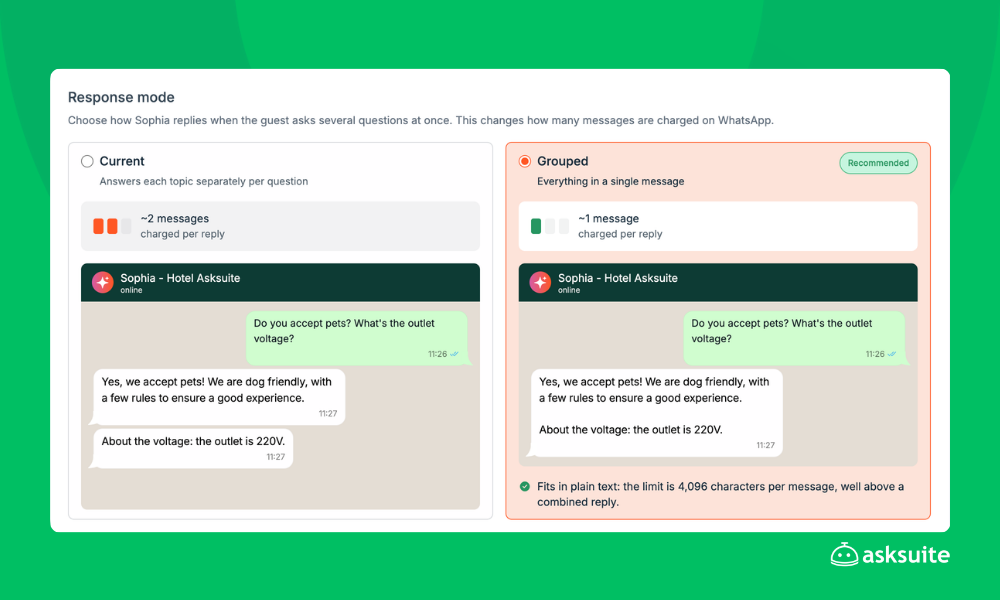
You’ll be able to configure multiple points in a conversation where the AI should combine information into a single message. For example, when answering questions with multiple topics, the AI will respond in one message.
3. Economy mode for quotes
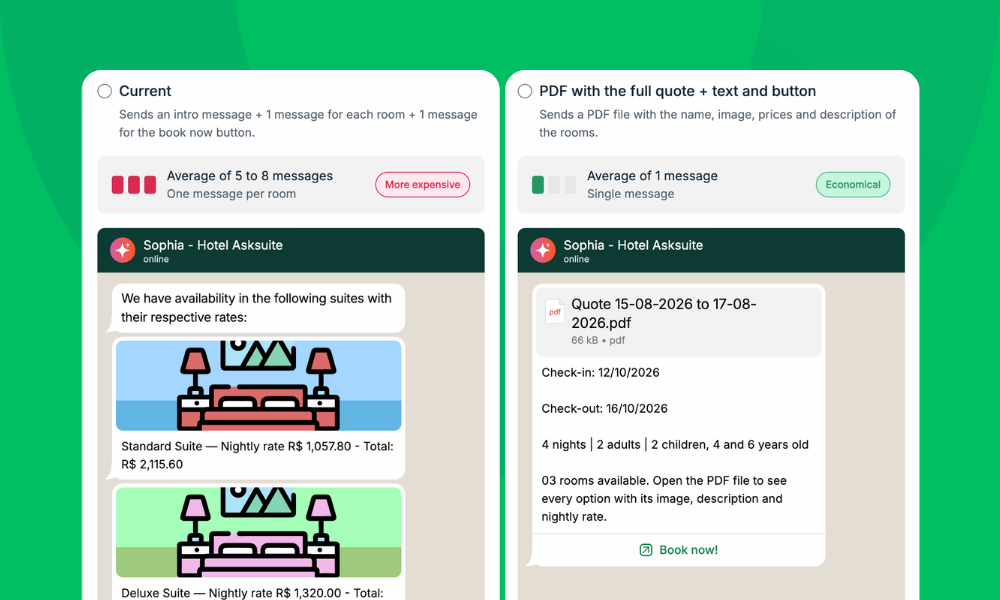
Asksuite’s current AI sends each room option in a separate message when providing quotes. With Economic Mode enabled, the quote can be turned into a PDF, accompanied by a single consolidated message. Our AI generates the PDF proposal with all room options, images, specific details, and buttons that redirect travelers to complete their booking through the booking engine.
4. Campaign preview in LiveChat
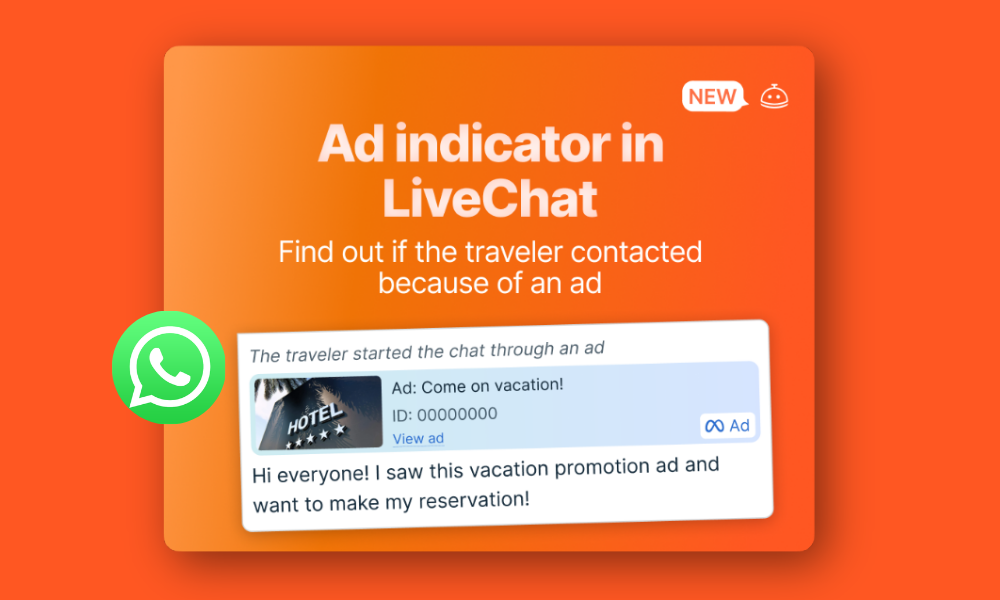
Today, 55% of Asksuite customers run “Click-to-WhatsApp” campaigns because this marketing strategy is effective at converting interest into direct bookings. To help turn this free 72-hour window into even better results, we’ve added a preview of the campaign that brought in each potential customer to the reservation agent’s Live Chat screen. This gives agents context from the very beginning, as they can see which ad sparked the customer’s interest.
5. Countdown to the end of the 72-hour free window for ads
This feature helps your team focus on converting customers who came from ads while they are still within the 72-hour free window, both in Live Chat and in Auto Kanban CRM.
6. New credit balance display
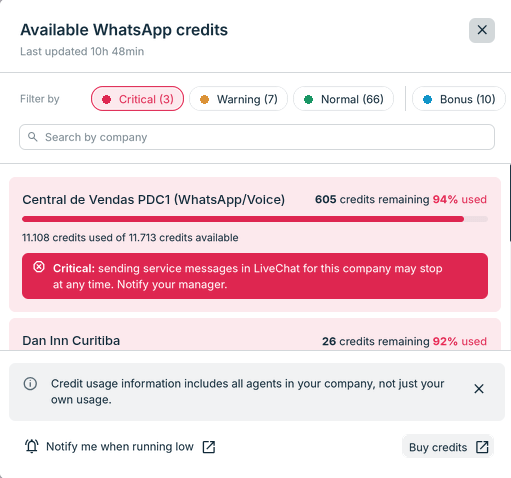
With service messages now being charged, monitoring your balance has become part of the daily routine. That’s why the credit balance window in Live Chat and Admin has been improved to make it clearer and more comprehensive, so you can see exactly how much credit remains and take action before it runs out.
What has changed in the balance window?
Meta’s free allowance is visible: You can track how many of the 1,000 free service messages per month remain before credits start being used.
Faster to read: The colors have been updated to highlight items that need attention, such as a low balance.
Top priority for accounts that need a top-up: If you manage more than one hotel, the property with the lowest credit balance and a low-balance warning always appears at the top of the list. This makes it easy to identify which property needs a top-up.

Real-time alerts for agents
In the Live Chat message field, agents can see before sending whether a message:
Will be charged and consume credits from the balance.
Falls within Meta’s free allowance and will not incur a cost.
Is being sent when credits are running low, allowing the manager to be notified in time.
This gives your team greater awareness of the cost of each reply during the conversation and helps them use Economic Mode more thoughtfully, while managers can prevent operations from being interrupted by a lack of credits. If you need a top-up, simply purchase credits through the e-commerce store; they are released as soon as payment is confirmed.
Which Asksuite usage strategies do we recomm
end?
If you still want to reduce costs after applying all of Asksuite’s new cost-optimization features, there are useful alternatives that can nearly offset the cost increase without harming sales performance.
The idea is that, since every message has a cost, WhatsApp should be used more — or exclusively — to generate revenue, bookings, and potential leads.
Strategy 1: Use WhatsApp only on conversion pages, with a stronger focus on cost efficiency
If your property handles a high volume of conversations and messages, displaying the WhatsApp button only on conversion pages — such as the booking engine, landing pages, and packages and promotions pages — may be an effective strategy.
You can keep only Asksuite’s web chat on your website and activate the post-quote WhatsApp prompt. This directs conversations to WhatsApp only when leads have reached the proposal stage and shown genuine purchase intent. This app is available for free in the AskStore, and you can configure any message to redirect your customer.
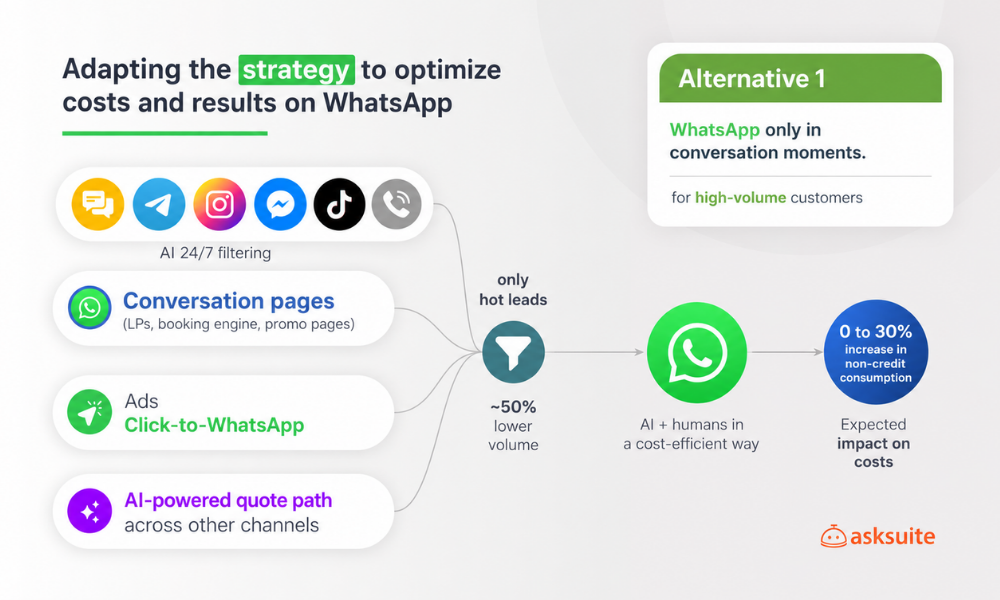
Since Click-to-WhatsApp ads remain free for 72 hours, they should also be part of your sales and marketing strategy.
Another option is to activate Telegram. Just as SMS incurred costs in the past and eventually gave way to WhatsApp as a free alternative, this new scenario may encourage companies to test other channels.
Telegram can be offered on the hotel website’s home page alongside web chat. Hotels can also use WhatsApp messages to redirect customers to Telegram. Nothing changes for reservation agents: because Asksuite is omnichannel, WhatsApp and Telegram conversations are automatically unified.
Important: Telegram is a new channel available exclusively to customers who already have the WhatsApp API integration product, WhatsApp Performance Suite.
Strategy 2: Keep WhatsApp as your main channel and optimize it with Economic Mode
WhatsApp plays a fundamental role in sales. Therefore, even with a slight increase in costs, it will still make sense in most cases to keep using and promoting the channel on the website’s home page with a floating button. This is especially true if you want to maximize lead capture. Keeping WhatsApp as your main communication channel and simply enabling Asksuite’s new Economic Modes for AI and human agents will already help reduce the cost impac
t.
An important reminder: These strategies can be adjusted throughout the year based on seasonality and occupancy rates. During the low season, you may want to promote WhatsApp more aggressively to capture more leads (Strategy 2). During the high
season, when the hotel is usually already fully booked, you can reduce the channel’s visibility and restrict it to conversion pages (Strategy 1).
When did the new charges take effect?
Meta announced the change on July 1, 2026, and confirmed the official rates before billing began on October 1.
- July 1, 2026: Meta announced the change.
- September 2026: Meta published the official pricing table by country.
- September 30, 2026: The last day on which replies within the 24-hour window were free.
- October 1, 2026: Billing began for service messages and Utility messages sent within the window.
How purchasing credits works at Asksu
ite
For Asksuite customers, the same method they are already familiar with in our platform applies: the credit balance will also be used for service messages, which consume only a fraction of a current credit.
To make topping up easier, you can already purchase credits directl
y through Asksuite’s e-commerce store, without contacting the sales
team or opening a support ticket.
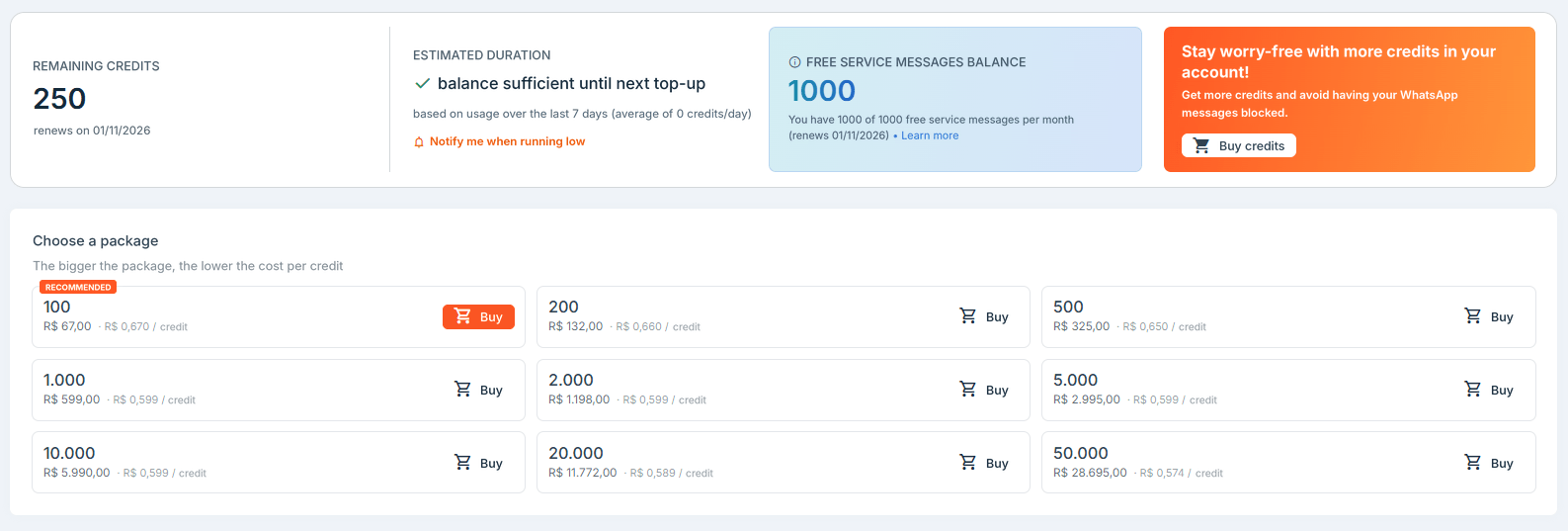
Important: Credits are added to your account as soon as payme
nt is confirmed. Purchase them in advance to avoid running out during high-volume periods, such as holidays and peak season.
Is it time to leave the official API?
The new charges affect all businesses worldwide that use the official WhatsApp Business API.
And, of course, turning to systems that use unofficial APIs is not the answer. Meta has already announced that it will strengthen its monitoring of unauthorized solutions, blocking and banning accounts and phone numbers operating through illegal APIs, with no possibility of appeal. In addition, these blocks can happen at any time and as a result of any type of activity, without prior notice. Click here to learn more.
The only “free” option would be to operate directly through the WhatsApp Business App, but this can end up costing much more in the long run. Here at Asksuite, we compare operating outside an official API to saving money by not purchasing a PMS and managing the hotel in an Excel spreadsheet. Excel is free, but fully manual management can cost you much more.
By using the WhatsApp Business App directly, without an API platform, you lose the professional channel management that makes WhatsApp such a major opportunity for direct hotel bookings. Here are some examples of what you would lose:
- High rate of account blocking, with no prior notice, since scammers always operate on regular or Business WhatsApp accounts, never on APIs. Many hotels come to Asksuite after having had their numbers blocked more than once.
- Advance notifications of ban risk in cases of outbound message abuse.
- Management and sales indicators by agent, company, and channel.
- A unified and secure lead database.
- Multiple users on the same number (limited to 4 on Business).
- Use of AI to increase productivity (only with Meta’s AI, which costs more than US$0.04 to US$0.05 per message/token, with no technical support and no hospitality features or integrations).
- Service distribution rules by agent and channel.
- Tag management and automation for contact qualification.
- Integrations with booking engines, PMSs, and marketing CRMs.
- Omnichannel view with all channels interconnected (WhatsApp, VoIP, social media, email).
- Real-time view of the sales funnel and open opportunities (Auto Kanban).
- Automated follow-up agents through AskFlow Agents.
- Conversion tracking that automatically feeds back into and optimizes Meta’s ad AI (coming soon).
- WhatsApp campaigns with open and conversion metrics.
- User access management and control.
Losing all these features would be like operating your main customer service and direct sales channel with virtually no control over your numbers, database, and other key information. The best path is to optimize usage while continuing to professionalize channel management and improve it through data.
How much does a service message cost?
At Asksuite, each message consumes credits according to the category defined by Meta:
Category | Credits per message | When it applies |
|---|---|---|
| Marketing | 1 | WhatsApp campaigns and outbound sales messages sent through AskFlow |
| Utility | 0.25 | Reactivating conversations that have been inactive for more than 24 hours and notifications sent through AskFlow |
| Service | 0.085 | Any reply to a traveler without a template (text, audio, or image), even within the 24-hour window |
Meta has a billing policy for service messages sent through WhatsApp, with rates that vary according to the traveler’s phone number country and the plan purchased. To better understand how billing works, check the applicable rates, and monitor usage, visit the page with the full information.
Each WhatsApp number receives 1,000 free service messages per month. Charges begin with message 1,001, and any unused allowance does not roll over to the following month. In other words, if your hotel sends 3,000 service messages per month, the first 1,000 are free and the remaining 2,000 cost approximately R$100, with packages starting at 1,000 credits.
Access the simulator here and see your estimated average cost based on your historical message volume, before and after applying the economy modes.

Important:
- The values are estimates based on your average historical volume.
- The simulator’s savings projections do not quantify the cost-reduction potential of implementing the strategies mentioned above, such as placing WhatsApp only on conversion pages.
The complete tutorial on how to use the simulator is available at the top of the page when you access the simulator link.
→ Simulate your new cost right now ←
Is WhatsApp still worthwhile for hotels despite the charges?
Absolutely. The cost of the channel is changing, not its value. The new rule simply reinforces the importance of managing the channel professionally and focusing even more on generating revenue.
Asksuite will be by your side, helping you further optimize the channel and its use to achieve the expected ROI.
Conclusion
The new charges are Meta’s decision and take effect on October 1, 2026, for anyone serving travelers through the WhatsApp Business API. Now it’s time to adapt fast, and that’s exactly what Asksuite will provide to customers: multiple operational options to make the channel more efficient.
Follow Asksuite on LinkedIn, Instagram, and subscribe to our Newsletter to stay on top of all the news about these changes and our upcoming launches.