4.9/5
4.9/5  HotelTechReport - with +970 verified reviews

Hospitality trends in 2026 stopped being conference panel material and became a line on the P&L. The year moved the conversation from “whether” technology belongs in the operation to “where” it protects margin first.
What makes this second half different is convergence. At the same time, you have distribution costs under pressure across markets, regulators rewriting the rules for OTAs, messaging channels changing their economics, and a traveler who starts researching accommodation somewhere other than a search engine.
This article is not a generic list of predictions. It is a cause and effect analysis of five fronts that should move your revenue before December, along with what you can act on in each one this year.
The starting point: a market selling at higher rates and growing less in volume
The global picture is one of solid demand growing at a slower pace than the post-pandemic surge suggested. International arrivals reached 1.52 billion in 2025, up 4%, and UN Tourism projects growth of 3% to 4% in 2026, conditional on Asia Pacific’s continued recovery and no geopolitical escalation.
Hotel performance tells a similar story almost everywhere. The most recent STR and Tourism Economics projections point to moderate, rate-driven RevPAR growth: around 1.4% across European markets, 4.4% in Asia Pacific and 2.8% in the United States for 2026, with a conservative outlook for the second half in Europe.
The strategic reading is: growth came from price, not volume.
That changes the weight of every new cost. When your incremental revenue comes from rate rather than from more bookings, each percentage point of commission, each underused channel and each unanswered lead eats a proportionally larger share of what is left.
Generative AI and autonomous agents move into the operation
Generative AI has become an operational tool in hospitality. In 2026, the focus shifts from simple chatbots to autonomous agents that execute tasks across the journey, such as quote follow-ups and upgrade offers, with a direct effect on efficiency and revenue.
Adoption tracks the market. According to the McKinsey and Skift report on agentic AI in travel, AI mentions in the annual reports of the largest travel companies jumped from 4% in 2022 to 35% in 2024, and nearly 60% of executives already credit AI with a productivity gain.
Capital followed the shift. Venture capital funding for AI travel startups went from roughly 10% of the total in 2023 to 45% in the first half of 2025, according to the same report. The question is no longer whether AI enters the operation, but where it creates value first.
Here is the distinction that matters for your hotel. A traditional chatbot answers message by message and waits for the traveler to start. An AI agent is proactive and completes the action.
Three points separate them:
- Initiative: the chatbot is reactive and runs on fixed rules. The agent identifies the right moment based on events and data.
- Autonomy: the chatbot returns an answer. The agent executes a task end to end.
- Integration: the chatbot lives in the website chat. The agent works across communication channels and inside hotel systems, such as the PMS, the property management system, and the booking engine.
In practice, a team of autonomous agents takes on the work that clogs the reservations department: recovering unfinished quotes with follow-ups timed to the traveler’s decision window, sending check-in and check-out instructions to the guest using PMS data, and re-engaging cold leads with personalized offers without waiting for a human agent to be available.
That design frees your human team for high-value hospitality. It is the reasoning behind the partnership between humans and robots in hotel service, and it is worth understanding how to use AI in hospitality before deciding where to start.
That combination is what drives results for properties like The Address Collective, which generated 523% ROI and close to 6,000 automated quotes in 2025 by pairing intelligent automation with its reservations team across website, Instagram and Facebook.
Distribution costs under pressure, with regulators in the middle of the game
OTA dependence kept climbing at exactly the moment it became more expensive. Brazil produced the most visible example of the year. Since July 1, 2026, Booking.com has applied an 18% commission to Brazilian properties in the Preferred Partner Programme, up from the historical 15% to 16%, while the standard rate for properties outside the programme remains at 15%.
The increase was announced with less than 60 days’ notice and led six industry bodies to file a complaint with CADE, the Brazilian antitrust authority, requesting suspension of the measure, in a move that directly affects hotel profitability.
The regulatory movement, though, is global and predates that:
- European Union: Booking.com was designated a gatekeeper under the Digital Markets Act, with obligations taking effect in late 2024, which led to the removal of parity clauses. The text also prohibits “measures of equivalent effect”, leaving open the debate around ranking mechanisms that produce the same outcome.
- Court of Justice of the EU: the ruling in case C-264/23, from September 2024, rejected the view that parity clauses are ancillary restraints necessary to the platform model.
- Spain: the CNMC issued a 413.24 million euro fine for abuse of dominant position tied to the enforcement of rate parity.
- Italy: the AGCM opened a new investigation in April 2026 into the Preferred Partner Programme and related programmes, this time under consumer protection law.
- Collective claims: national hotel associations across dozens of countries have organized to seek damages for years of parity clauses.
In markets where parity has fallen, you have the legal freedom to offer better conditions on your direct channel, and that freedom only counts for something if your direct channel knows how to convert. In markets where parity still applies, the path is differentiating on value: perks, flexibility, upgrades, cancellation terms, everything that is not the price on the screen.
In both scenarios the conclusion is the same. Raising your OTA rate to offset commission is not a sustainable answer, because it penalizes your visibility in the platform’s algorithm. Reducing channel dependence is the lever that remains under your control, which starts with owning the infrastructure for it, so it is worth understanding how a booking engine works as direct sales infrastructure before deciding where to act.
Run the numbers before you react. Three extra percentage points mean 300 more in commission for every 10,000 sold through that channel. Check your property’s actual terms in the extranet, because increases like this usually apply to specific programmes rather than the entire base.
Messaging channels: more important, and no longer free
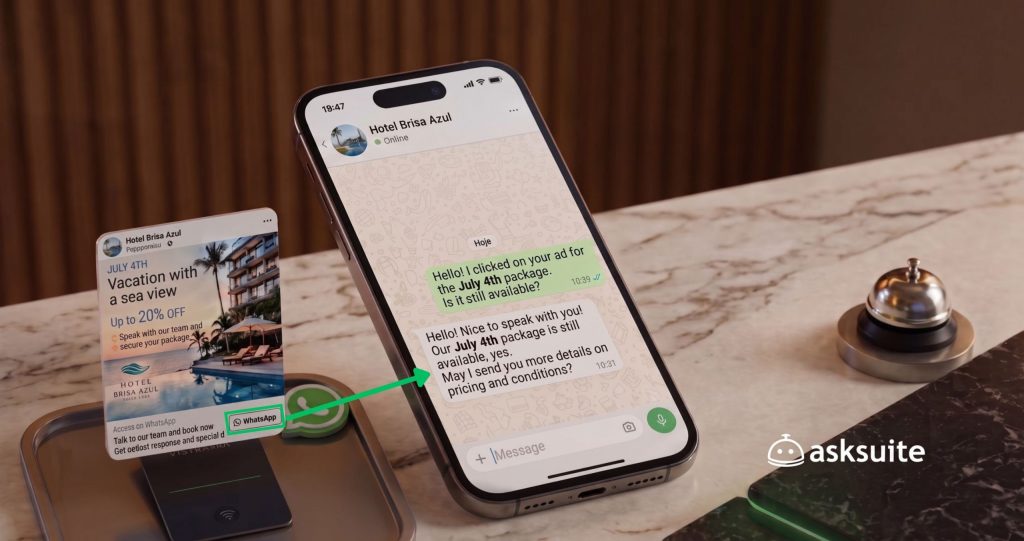
WhatsApp remains the most relevant direct channel for travelers across much of Latin America, Europe, the Middle East, Africa and Asia, and it is where direct sales conversations actually happen.
Two changes deserve your attention now.
The first is cost. Meta continues moving the WhatsApp Business API toward per-message billing, and from October 1, 2026 service replies sent inside the 24-hour window become billable, per the official pricing documentation.
The practical effect is easy to anticipate: the volume of messages your hotel sends becomes a predictable cost line. Start measuring that volume now, and treat the channel as a managed funnel rather than an inbox, which is the difference between WhatsApp as a reactive channel and WhatsApp as a revenue engine.
The second change works in your favor. WhatsApp username reservations opened globally at the end of June 2026, with a gradual rollout. Hotels will be able to publish a fixed identifier, something like @examplehotel, instead of a phone number, and a traveler who knows that username can start a conversation without saving a contact.
Two caveats: there is no public search directory, so the username is an address you promote rather than a discovery channel, and it is worth confirming with your official provider that your integrations are ready for the identifier that replaces the phone number for travelers who choose to hide it.
When travelers stop arriving through search: generative AI and agentic booking
This is the trend that gets the least airtime in hallway conversations and that should reshape your funnel most over the next two years. It is global by nature, because it does not depend on local regulation or market.
The research starting point has changed. In SiteMinder’s Changing Traveller Report 2026, based on 12,000 travelers across 14 countries, OTAs overtook search engines as the starting point for accommodation research for the first time, at 26% against 21%, with search engines falling from 36% in the previous edition.
At the same time, travelers who do reach a search engine click less. AI-generated answers absorb intent before the click, and travel categories are among the hardest hit by declining organic referral traffic in nearly every market measured.
The flip side is the quality of what remains. Traffic arriving from AI interfaces is pre-qualified, because the traveler already compared options inside the conversation before clicking. Fewer visits, warmer intent.
And the next layer is already being built. Booking and Expedia launched apps inside ChatGPT, Google announced agentic booking inside AI Mode, and hotel chains have started processing reservations through that path. The open debate in the industry is who collects the commission on this new route, and the answer does not exist yet.
IDC sums up the structural effect: discovery, comparison, booking and service become mediated by intelligent agents acting on the traveler’s behalf, which redesigns the entire distribution funnel.
What to do about it in 2026, without falling for empty promises:
- Treat your content as a source, not as bait. Pages that answer concrete questions about the destination, the property and your policies are the ones models can cite with confidence.
- Fix your structured data. Schema.org, consistent amenity, policy and location information are the same investment that makes your hotel appear in a recommendation and readable by an agent.
- Look after your Google Business Profile. A large share of clicks originating from AI answers inside the Google ecosystem still lands there.
- Treat reviews as a recommendation signal. Volume, rating and above all recency support the confidence with which a model recommends your property.
- Measure. Create a traffic segment for AI sources in your analytics and track the trend instead of debating it in the abstract.
If you want the technical checklist behind this, we covered it in how to optimize your hotel website for the era of AI search. And be skeptical of any vendor promising guaranteed AI citations or a certification badge. No guaranteed inclusion mechanism and no certifying body exist for this.
Redesigning the workforce: humans empowered by AI
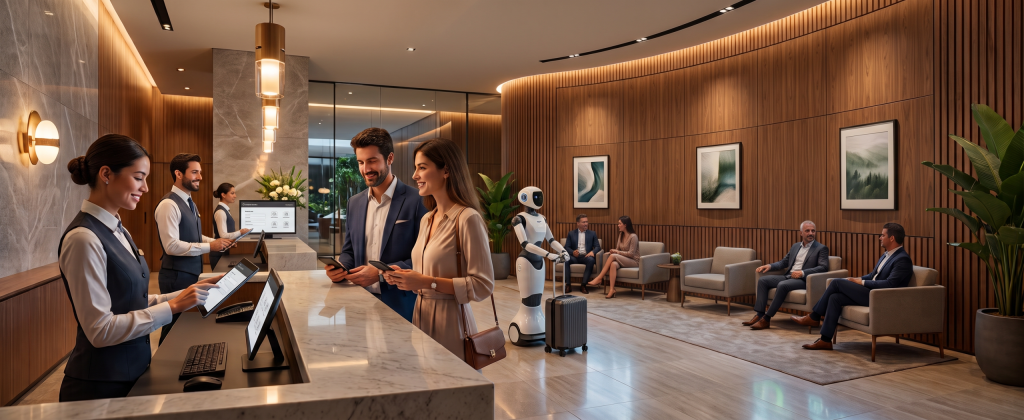
The biggest trend of 2026 is not humans being replaced by AI, it is humans being equipped by it. Automating repetitive tasks gives reservations and front desk teams time for consultative selling, complex upselling and the experiences that build loyalty and positive reviews.
Market evidence points that way. In the McKinsey and Skift survey, nearly 6 in 10 travel executives associate AI with higher productivity, not with fewer people.
The reservations agent role evolves into that of a travel advisor. While automation quotes rates and checks availability at any hour, the human steps in to negotiate a honeymoon package, sell an experience or handle a corporate group.
An example makes it concrete. AI answers the hundredth question about breakfast hours and cancellation policy while your agent negotiates a 30-room group. Both conversations happen at once and neither blocks the other.
This transition works best when the agent sees the whole traveler, which is where a well-defined omnichannel strategy comes in, centralizing channels in one place.
How to prepare your team for the AI era:
- Task audit: map what is repetitive and can be automated, such as answering the same question about check-in times.
- Focused training: build skills in consultative selling, hotel storytelling and upselling techniques.
- New KPIs: replace “response time” with qualified lead conversion rate and incremental revenue per interaction.
- Integrated tools: make sure your AI platform talks to your CRM and your PMS.
- Clarity in replies: with messaging channels moving to per-message billing, one complete answer is worth more than several fragmented ones.
Team productivity and revenue move together. It is worth reading how that connection plays out in a full hotel sales strategy.
Predictive data and climate events: a new layer in revenue management
Revenue management in 2026 goes beyond seasonality and competitor analysis. Integrating macro data, such as climate forecasts and regional event calendars, allows for more precise and proactive dynamic pricing.
Climate is already moving demand measurably. UN Tourism has warned that extreme weather events are shifting tourism flow patterns, with travelers migrating toward milder destinations during traditional peak seasons.
The behavior earned a name in the European market, coolcation, and it shows up in both hemispheres. Extreme summers push demand from the Mediterranean toward northern Europe, and phenomena like El Niño and La Niña shift regional demand in South America, where a milder winter can empty mountain hotels while off-season heat redistributes flow between coastal destinations.
To respond, revenue managers need tools that process non-traditional data. Cross-referencing demand, weather, local events and competitor pricing in real time has moved from differentiator to requirement for getting the rate right.
The anomaly also opens space for targeted campaigns. An off-season heat wave justifies a “escape the heat, enjoy the pool and air conditioning on special terms” campaign, capturing demand that historical seasonality never predicted.
In practice, this requires an integrated stack. The PMS feeds occupancy history, the intelligence platform cross-references it with weather and regional events, and the revenue management system adjusts the rate before competitors notice the shift. Without that connected layer, dynamic pricing keeps reacting too late.
Frequently asked questions
Will artificial intelligence replace my reservations team?
No. The trend is for AI to take on repetitive tasks, freeing the human team for complex sales, negotiations and personalized service, acting as strategic travel advisors.
What are autonomous agents in hospitality?
They are AI systems that, unlike chatbots, act proactively and complete tasks end to end across the journey, such as recovering unfinished quotes, sending check-in instructions via the PMS and re-engaging leads, integrated with hotel systems.
Why did OTA commissions become an issue in so many countries at once?
Because channel dependence grew while regulators started examining platform rules. In Europe, the Digital Markets Act and court rulings struck down parity clauses. In Brazil, industry bodies took a 2026 commission increase to the antitrust authority. Different processes, same root cause: distribution concentration.
Does rate parity still apply in my market?
It depends on the country. Across much of Europe, the clauses have been removed or banned. In other markets they remain in force. Confirm with your legal team before advertising a lower direct rate, and where parity applies, differentiate on added value rather than on price.
How do I get my hotel to appear in AI answers like ChatGPT and Gemini?
There is no guaranteed inclusion. What works is owned content answering concrete questions about the destination and the property, consistent structured data, an updated Google Business Profile and recent reviews in volume. Be skeptical of anyone promising guaranteed citations or selling a certification badge.
What is the first step to reduce dependence on OTA commissions?
Optimizing your direct service channels. An omnichannel solution that centralizes WhatsApp, Instagram, website chat and email, with automation, makes sure no direct booking lead is lost to a missing reply.
What changes in practice with WhatsApp usernames?
A traveler who knows your username can start a conversation without saving a number, which reduces first-contact friction. There is no public search directory, so the username works as an address you promote, not as a discovery channel.
How do I start using predictive data in my pricing strategy?
Integrate your PMS with an intelligence platform that analyzes market data, and track local event calendars and climate reports to spot demand patterns that are not obvious, adjusting rates ahead of time.