4.9/5
 HotelTechReport - with +970 verified reviews


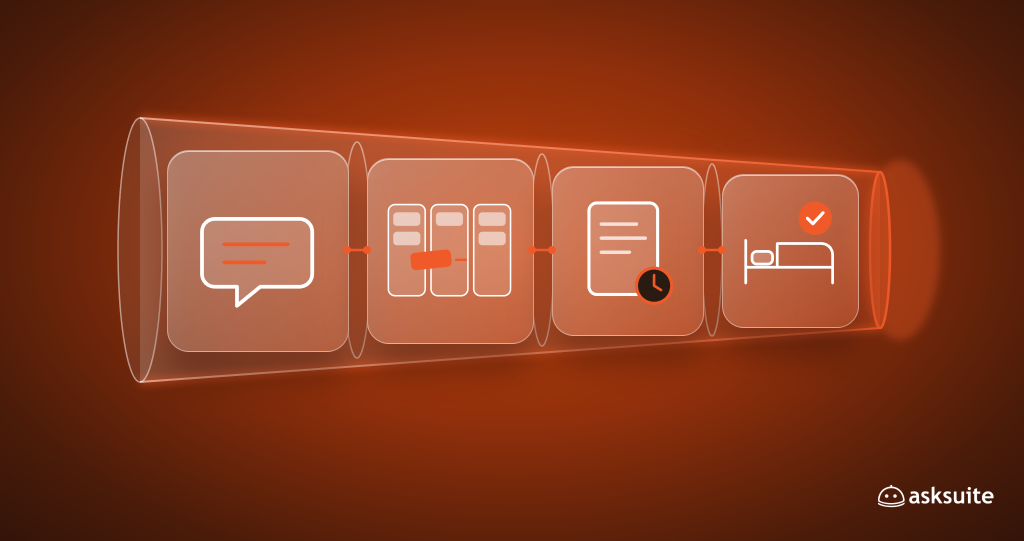
A hotel sales funnel is the path an opportunity follows from the traveler’s first contact to a confirmed booking. When it is well designed, you can see which stage each negotiation is in, who owns it and where the process gets stuck.
If your hotel receives inquiries, sends quotes and still watches opportunities go cold, the problem is rarely a lack of demand. In most cases, the loss starts long before closing: a slow reply, a quote with no context or a follow-up nobody took ownership of.
In this guide, you will learn how to structure each stage of the funnel, split responsibilities between reservations and sales, track opportunities on a Kanban board and choose the indicators that show where to act.
What is a hotel sales funnel
A hotel sales funnel is the process that connects customer service, reservations and sales until the booking is confirmed. It is not a tool. It is the way the hotel organizes stages, owners, deadlines and criteria so that every contact moves forward clearly.
The core of the funnel usually has five stages: first contact, qualification, quote, follow-up and confirmed booking. The table below shows what goes into and comes out of each stage and who usually owns it. Use it as a starting point and adapt it to your operation.
| Stage | What comes in | What comes out | Owner |
| First contact | Rate, availability or group request | Opportunity logged | Reservations team |
| Qualification | Dates, traveler profile, channel and opportunity value | Priority defined | Reservations or sales |
| Quote | Rate and policies matched to the profile | Proposal sent with an expiry date | Reservations or sales |
| Follow-up | Traveler reply or silence | Negotiation moved forward or loss logged | Opportunity owner |
| Confirmed booking | Acceptance and guarantee | Booking logged in the PMS | Reservations team |
Each stage needs a simple criterion to move to the next one. Records should also follow the same standard, whatever PMS the hotel uses and whatever channel the contact comes from: website, phone, WhatsApp or OTA. That is what turns the funnel into an accurate picture of your operation instead of a generic CRM template.
Reservations and sales: who owns each stage
The funnel works best when the reservations team and the sales team have clear roles. Reservations comes in first, replies quickly, screens the request and logs the contact. Sales takes over when the opportunity calls for a consultative proposal, a longer negotiation or more active follow-up.
| Reservations team | Sales team | |
| Main role | Volume, fast replies and screening | Consultative negotiation |
| Stages it leads | First contact, initial qualification and booking entry | Tailored proposal, negotiation and re-engagement of hot opportunities |
| Type of contact | Standard rate and availability requests | Groups, corporate accounts, events and travelers with flexible dates |
Some responsibilities belong to both teams: logging the next step and the loss reason, meeting the agreed SLA and keeping a single history for each opportunity. When the handoff between reservations and sales is not documented, the opportunity loses its owner. And without an owner, follow-up slips.
If you are building or reorganizing these teams, it is worth seeing how to structure a high-performance reservation center and how to build a hotel sales team.
Where opportunities are lost and how to fix it
Losses in a hotel funnel concentrate in a few points: slow replies, generic quotes, follow-up without a routine, owner changes without records, information scattered across channels and unclear priorities. Almost all of them are operational bottlenecks, and each has a direct fix.
| Bottleneck | What happens | How to fix it |
| Slow reply | The traveler hears from another hotel before hearing from you | Set an SLA by channel and by type of contact |
| Quote without context | The proposal is generic and ignores dates, profile and trip purpose | Use a template with minimum fields, policies and traveler context |
| Follow-up without a routine | The quote goes out and nobody knows when to follow up | Set a cadence with deadline, time and owner |
| Owner change without records | The opportunity moves from reservations to sales and the history is lost | Document the handoff in the opportunity history |
| Scattered information | Email, WhatsApp, spreadsheets and OTAs create different versions of the same negotiation | Keep each opportunity in a single history |
| No priority or loss reason | The team does not know what to tackle first or why negotiations stall | Sort by urgency and classify losses by price, timing, availability, policy or silence |
The first bottleneck in the table deserves special attention. Hotel response time weighs directly on the traveler’s decision, and tracking the SLA on an SLA dashboard shows which channels and agents are taking longer.
Notice also that losses do not happen only at checkout. They build up across the decision journey, which is why pre-booking customer service matters so much. And when each channel works in isolation, rework grows. Understanding the difference between a multichannel and an omnichannel hotel helps solve that.
How to use Kanban to track opportunities
A Kanban board shows which stage each opportunity is in, who owns it and how long it has been stalled. It works because it takes the negotiation out of the team’s memory and puts it on a visual board, with status, deadline and priority.
The most useful columns follow the funnel stages:
- New contact
- Qualification
- Quote sent
- Awaiting reply
- Confirmed booking
- Lost
For the board to show real progress, not just movement, each card needs three pieces of information: owner, next step and review date. In the daily routine, follow this checklist:
- Assign a single owner to each opportunity.
- Use labels for channel, rate type and urgency.
- Log the next contact on the card itself.
- Move a card only when the exit criterion is met.
- Review stalled cards every day.
Kanban does not replace a CRM. The board organizes the flow visually, while the CRM stores the data and history. Ideally, both live in the same place where customer service happens.
Automatic Kanban: when the board updates itself
The biggest risk of a manual Kanban board is falling out of date. If the team has to remember to move every card, the board stops reflecting reality precisely on the busiest days.
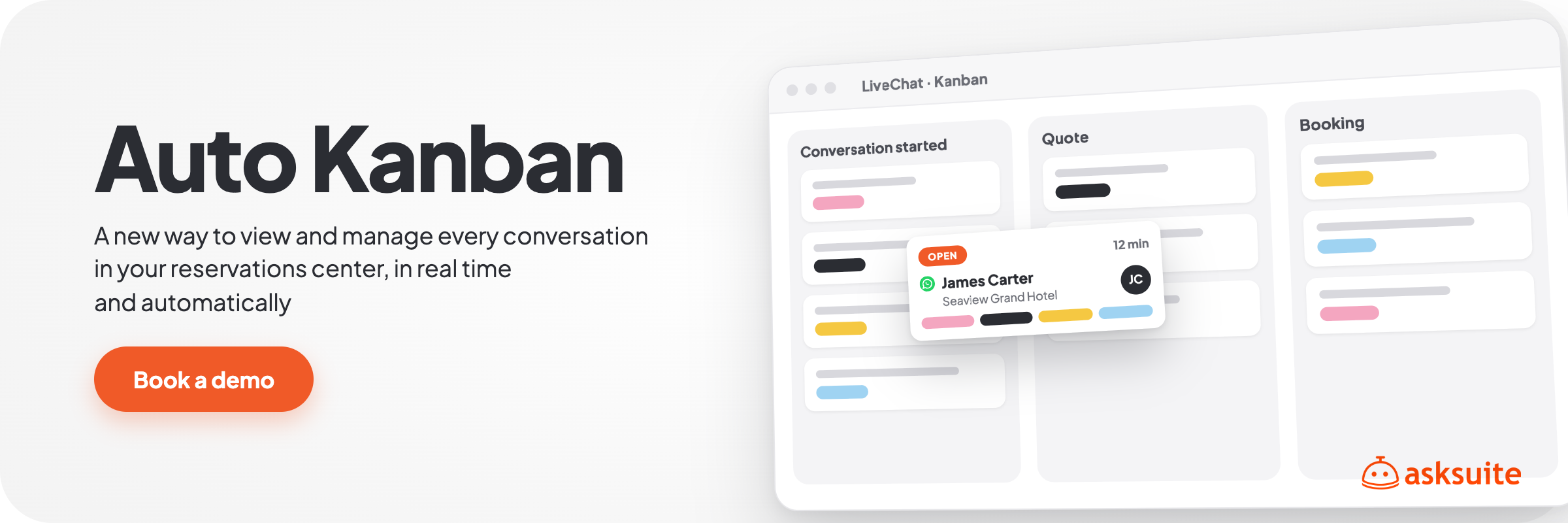
That is the problem Asksuite’s Auto Kanban solves. It turns the LiveChat conversation list into a booking funnel organized by stages. Cards move between columns on their own as the conversation evolves, based on automatic labels or labels created by the hotel. You can see how many proposals are open, which stage each one is in and how long each traveler has been waiting for a reply, without opening a single conversation.
The default funnel is ready to use, and you can create custom funnels with your reservations team’s own stages and rules. Since a stalled quote is one of the main bottlenecks, it is also worth having a clear follow-up strategy for every card sitting in awaiting reply.
Which KPIs to track at each funnel stage
To measure your hotel sales funnel, track a few KPIs and tie each one to a stage. The goal is not to pile up numbers, but to find where the process breaks and what action the operation needs to take.
| KPI | Stage | What it shows | What to do with it |
| Contact volume | First contact | How many opportunities come in | Size the team and channels |
| Response time | First contact | Speed of the first reply | Adjust the SLA |
| Qualification rate | Qualification | How many contacts become opportunities | Review screening |
| Follow-up rate | Follow-up | How many quotes get a follow-up | Fix the cadence |
| Close rate | Confirmed booking | How many opportunities become bookings | Analyze the final stage |
| Loss reason | All | Why the negotiation stopped | Adjust process and offer |
| Conversion by channel and campaign | All | Which sources bring opportunities that become bookings | Reallocate priorities and investment |
A good KPI leads to a clear action, it does not just fill a report. To go deeper, see the 6 main hotel KPIs for sales and reservations teams.
Connecting the funnel to the source of demand
The last indicator in the table is often the hardest to measure. Marketing sees clicks and started conversations. Operations sees the booking logged in the PMS. Without linking both ends, a campaign that generates many messages and few bookings can look better than one that brings fewer contacts but higher-value negotiations.
Atlas, Asksuite’s solution for hotels that use the WhatsApp Performance Suite, connects the traveler journey to confirmed bookings in the PMS. With it, you can track how each booking is attributed to the channels in the journey, conversion by campaign and by agent, and indicators such as ROAS and cost per booking.
That makes it easier to tell whether a drop in results comes from the source of the contacts or from how negotiations are handled in the funnel. The same applies to Click-to-WhatsApp ads, where the negotiation starts in the ad and continues in the conversation with your team.
How to structure your hotel sales funnel in 7 steps
You can start with the basics. First, map what already happens today. Then simplify the stages, define owners and create handoff rules everyone understands.
- Map the current process. See how contacts come in, who replies and where they stop.
- Define the funnel stages. Use few stages with clear names.
- Assign owners. Each opportunity needs a single owner.
- Standardize messages and deadlines. Quotes and follow-ups need a routine.
- Create a single record per opportunity. Avoid history scattered across email, WhatsApp and spreadsheets.
- Set up a Kanban board. Make the negotiation visible to the whole team and, if possible, automate card movement.
- Review KPIs every week. Track what stalled, what moved forward, what was lost and where bookings came from.
With a structured funnel, sales management gains predictability, depends less on specific people and spots bottlenecks faster. Without a process, the hotel sees effort. With a process, it sees flow. This also applies to smaller hotels: the leaner the team, the more important it is to be clear about stage, priority and owner. To set goals and priorities before putting the funnel to work, check out this hotel sales planning guide.
Want a practical example? The Malai Manso Resort case shows how an AI agent took over the early funnel stages and guided travelers all the way to booking, freeing the team for higher-intent opportunities.
Frequently asked questions
What is a hotel sales funnel?
It is the path an opportunity follows from the traveler’s first contact to a confirmed booking, through qualification, quote and follow-up. The goal is to make the process visible and keep opportunities from getting lost along the way.
What are the stages of a hotel sales funnel?
The most common stages are first contact, qualification, quote, follow-up and confirmed booking. Some hotels also add post-sale and reactivation, but that is usually the core of the sales funnel.
Why do hotels lose booking opportunities?
Usually because of slow replies, inconsistent quotes, lack of follow-up and information scattered across channels. In most cases, the problem is not a lack of demand but a lack of process and visibility over each opportunity.
How do you use Kanban for hotel sales?
Create columns that follow the funnel stages, such as new contact, quote sent, awaiting reply and confirmed booking. Each card should have an owner, a next step and a review date. On an automatic Kanban board, cards change columns as the conversation moves forward.
Does Kanban replace a CRM?
No. Kanban organizes the flow visually, while the CRM centralizes data and history. In many hotels, both work together to give visibility and traceability to the sales process.
What is the difference between reservations and sales in a hotel?
The reservations team handles fast replies, screening and standard requests. The sales team steps in when the negotiation calls for a consultative approach, a tailored proposal or more active follow-up.
Which KPIs should you track in a hotel sales funnel?
The most useful are contact volume, response time, qualification rate, follow-up rate and close rate. Classifying loss reasons and measuring conversion by channel and campaign also helps you understand where the process breaks.
Is a sales funnel useful for small hotels?
Yes. The smaller the team, the more important it is to be clear about stage, priority and owner. In small hotels, the funnel reduces reliance on memory and keeps service consistent.