4.9/5
4.9/5  HotelTechReport - with +970 verified reviews

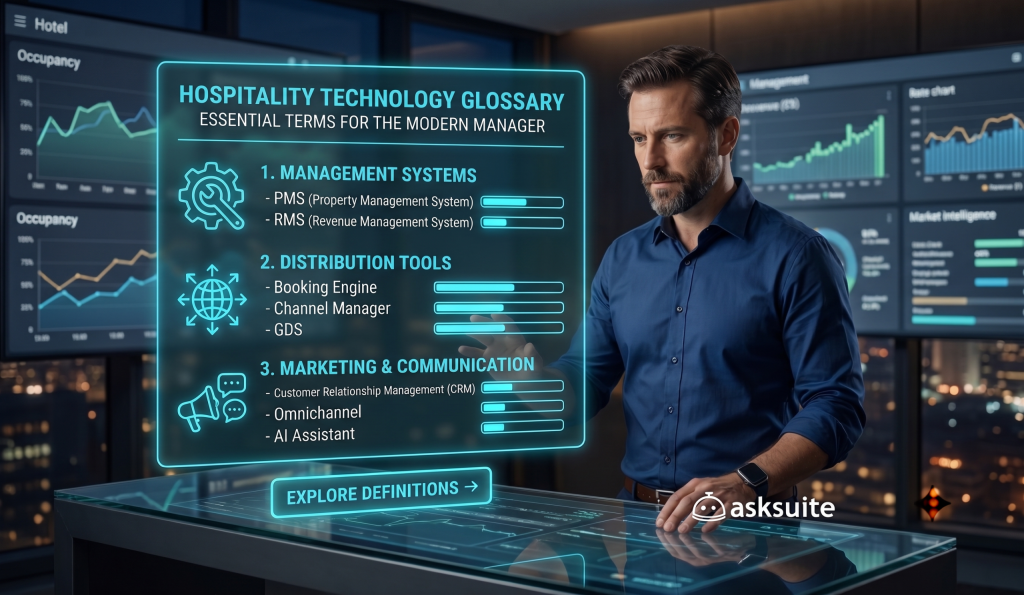
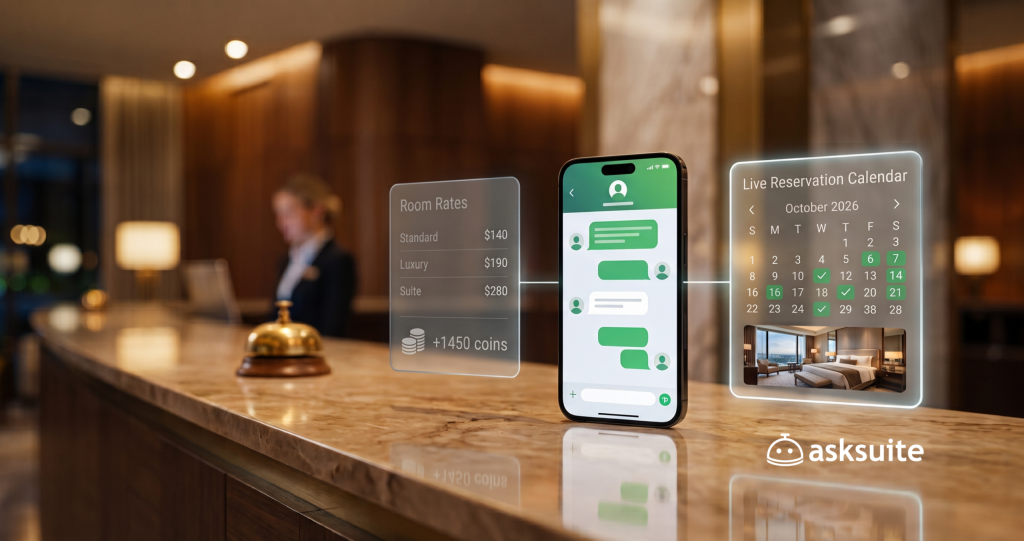
The hospitality technology ecosystem can seem like a maze of acronyms and jargon. Between PMS, CRM, RMS, and API, it’s easy to feel lost and unsure about which tools truly matter for your operation and what the latest hotel technology trends are.
This definitive hotel technology glossary was created for you, the hotel manager. Here, we will demystify the most important terms in the industry in a clear and direct way, showing not only “what it is” but “why it matters” for your revenue and operational efficiency.
The Foundation of Everything: What is a Hotel Tech Stack?
The Hotel Tech Stack is the set of all systems and software that a hotel uses to manage its operation, distribution, marketing, and customer experience. It integrates tools like PMS, booking engines, and CRM to automate processes and optimize results.
Think of the tech stack as your hotel’s “digital ecosystem.” It’s like a team where each player (software) has a specific position, but they all need to play together in an integrated way to increase revenue and traveler satisfaction.
According to industry experts, the concept of a “hotel tech stack” is central to modernizing management. A well-structured tech stack avoids manual work, reduces errors, and provides a 360-degree view of the business and your customer.
Hotel Management and Operation Systems
Before you can sell, you need to get your house in order. Management systems are the backbone of hotel operations, ensuring everything runs efficiently behind the scenes, from room control to dynamic pricing. They are the foundation upon which your entire sales and marketing strategy will be built.
What is a PMS (Property Management System)?
A PMS is the central nervous system of the hotel. It is the software that manages reservations, room availability, check-in and check-out processes, billing (guest accounts), and basic customer profiles. Essentially, it is the main work tool for the front desk.
Without a PMS, managing a hotel would be a chaos of spreadsheets and manual notes, making growth and efficiency nearly impossible. It is the most fundamental piece of technology for any property, regardless of size.
For example, when a receptionist performs a check-in, they are using the PMS. Similarly, when the housekeeping team updates a room’s status to “clean,” this update is made directly in the PMS, making the room available for sale in real-time.
What is an RMS (Revenue Management System)?
A Revenue Management System is software that uses market data, historical occupancy, and competitor analysis to recommend the ideal rate for each room, every day. Its goal is to maximize the hotel’s revenue and profitability.
The importance of an RMS lies in eliminating “guesswork” in pricing. It helps sell the right room to the right customer at the right time and for the right price, applying data intelligence to your pricing strategy. According to STR, optimizing RevPAR (Revenue Per Available Room) is a key indicator of success, and the RMS is the key tool for this.
A practical example is when the RMS suggests increasing the rate for a holiday 30 days in advance, predicting high demand, and then creates a last-minute promotion for remaining rooms on a low-season Tuesday.
Distribution and Direct Sales Tools
Once the operation is organized, the focus shifts to how your rooms reach travelers. Distribution and sales tools are the bridges that connect your inventory to the global market and, more importantly, to your direct booking channel, which is the secret to more profitable hotel direct bookings.
Online bookings continue to dominate the industry, highlighting the critical need for efficient digital distribution tools.
What is a Booking Engine?
The booking engine is your hotel’s e-commerce software. Integrated directly into your official website, it allows travelers to check availability, see real-time rates, and make a direct booking without intermediaries.
This is the most important tool for increasing direct bookings, which are significantly more profitable as they do not involve paying commissions to third parties. Understanding in detail what a booking engine for hotels is is the first step to strengthening your most valuable sales channel.
What is a Channel Manager?
A channel manager is a platform that centralizes and automatically synchronizes your room inventory and rates across all your online sales channels. This includes your own website (connected to the booking engine) and various OTAs, such as Booking.com and Expedia.
Its main benefit is preventing overbooking, which occurs when the same room is sold twice on different channels. Additionally, it saves hours of manual work that would be spent updating availability and rates on each platform individually.
What is a GDS (Global Distribution System)?
The Global Distribution System is a worldwide network that connects hotels to traditional travel agencies and large corporations, primarily for managing business travel bookings. The best-known systems are Amadeus, Sabre, and Travelport.
For hotels with a strong focus on the corporate audience or located in major urban centers, the GDS is a fundamental distribution channel. It ensures your property is visible and bookable where large business travel buyers make their quotes and contracts.
What is an OTA (Online Travel Agency)?
An OTA, or Online Travel Agency, is a marketplace website like Booking.com, Expedia, Airbnb, and Decolar. They function as a large storefront for thousands of hotels, investing heavily in marketing to attract travelers and sell rooms in exchange for a commission per booking.
OTAs offer immense visibility and market reach, a phenomenon known as the “billboard effect,” where a traveler discovers the hotel on the OTA and then seeks it out to book direct. Modern hotel strategy aims to balance sales via OTAs with strengthening direct sales to optimize profitability.
Channel Comparison: OTA vs. GDS vs. Direct Booking
| Channel | Primary Target Audience | Cost Model | Hotel Control |
| OTA | Leisure travelers and individual business travelers | Commission per booking (15-25%) | Low control over customer relationship |
| GDS | Travel agencies and corporations | Transaction fee + commission | Medium control, focused on the B2B segment |
| Direct Booking | All audiences | Marketing and technology cost (fixed) | Full control over brand, price, and relationship |
Marketing and Traveler Communication Platforms
Attracting a traveler to your website is only half the battle. The other half is converting their curiosity into a booking. Marketing and communication platforms are designed to engage, answer questions, and guide the traveler through the booking journey efficiently and personally.
Hotels that adopt omnichannel communication can respond up to 5x faster to quote requests. This happens because information, whether from Instagram, WhatsApp, or the website chat, arrives in a single dashboard, allowing the reservations team to act in a centralized manner.
What is a CRM (Customer Relationship Management)?
A hotel CRM is a system for managing relationships and interactions with current and potential customers. It stores demographic data, preferences, stay history, and communication to personalize marketing, offers, and service.
Its importance lies in its ability to build loyalty. A CRM allows you to treat a returning traveler like an acquaintance, offering them relevant upgrades or promotions.
According to a survey by Oracle Hospitality published by Skift, 73% of travelers want hotels to use technology to create more personalized experiences, and CRM is the foundation for this. Integrated tools can transform your reservations center into a loyalty engine.
What is an omnichannel platform?
An omnichannel solution unifies all digital communication channels (WhatsApp, Instagram, website chat, email) into a single inbox for the hotel team. It allows reservation agents to converse with travelers without needing to switch between different screens and applications.
Being omnichannel ensures that no message or sales opportunity is lost. Furthermore, it offers a seamless experience for the traveler, who can start a conversation on Instagram and finish it on WhatsApp without having to repeat all the information.
Research from Phocuswright confirms that messaging is an integral part of the modern traveler’s booking journey. An all-in-one traveler communication platform is a practical example of this concept.
What is an AI booking assistant?
An AI booking assistant is an Artificial Intelligence specifically trained for the hotel industry. It is capable of understanding questions in natural language, checking rates and availability from the booking engine in real-time, providing accurate quotes, and even initiating the booking process.
Its great advantage is the automation of 24/7 service. It frees up the reservations team from repetitive tasks so they can focus on complex negotiations, group sales, and consultative service, which generate more revenue. Learning how to use AI in hospitality is a direct competitive advantage.
What is the difference between a chatbot, an AI assistant, and an AI agent?
- Chatbot: Based on fixed rules. Responds to a predefined menu of questions (e.g., “Type 1 for location, 2 for breakfast times”). It doesn’t understand context or open-ended questions.
- AI Assistant: Conversational. Uses AI to understand the user’s intent, answer open-ended questions (e.g., “How much is the daily rate for 2 adults and 1 child in January?”), consult the booking engine, and provide real-time quotes.
- AI Agent: Autonomous. Besides conversing and quoting, it is capable of executing complete tasks without human intervention, such as actively following up on a quote via email, processing a payment, and confirming a booking in the system.
Frequently Asked Questions
Q: What is the difference between a PMS and a CRM in hospitality?
A: The PMS (Property Management System) manages the hotel’s internal operations, such as rooms, check-ins, and billing. The CRM (Customer Relationship Management) manages the relationship with the traveler, storing data and preferences to personalize marketing and communication before, during, and after the stay.
Q: Does my hotel need all of these systems?
A: Not necessarily. A small hotel can start with a good PMS and a booking engine. As the operation grows, tools like a Channel Manager and an omnichannel platform become essential for managing complexity and not missing sales opportunities.
Q: Is a booking engine the same as an OTA?
A: No. The booking engine is your online store, located on your own website, where you sell your rooms without paying a commission. An OTA (Online Travel Agency) like Booking.com is a third-party marketplace that sells your rooms in exchange for a high commission on each booking.
Q: What does API mean in hospitality?
A: API (Application Programming Interface) is a technological “bridge” that allows different systems (like your PMS and your booking engine) to talk to each other and exchange data automatically. APIs are fundamental for your tech stack to work in an integrated and efficient way.
Q: Does an AI assistant replace the reservations team?
A: No. A qualified AI assistant automates repetitive, low-value tasks, such as answering questions about pool hours or whether the hotel is pet-friendly. This frees up the human team to focus on complex negotiations, group sales, and personalized service, which generate more revenue.
Q: Is omnichannel just about having multiple service channels?
A: No. Having multiple channels is being multichannel. Being omnichannel means that all these channels are integrated into a single platform, providing a unified experience for the traveler and your team, which manages all conversations from one place, without losing the history.